Commentary
Democratic Security
Buy American, Build European? CEE’s New Defence Strategy
7 October 2026

7 May 2026
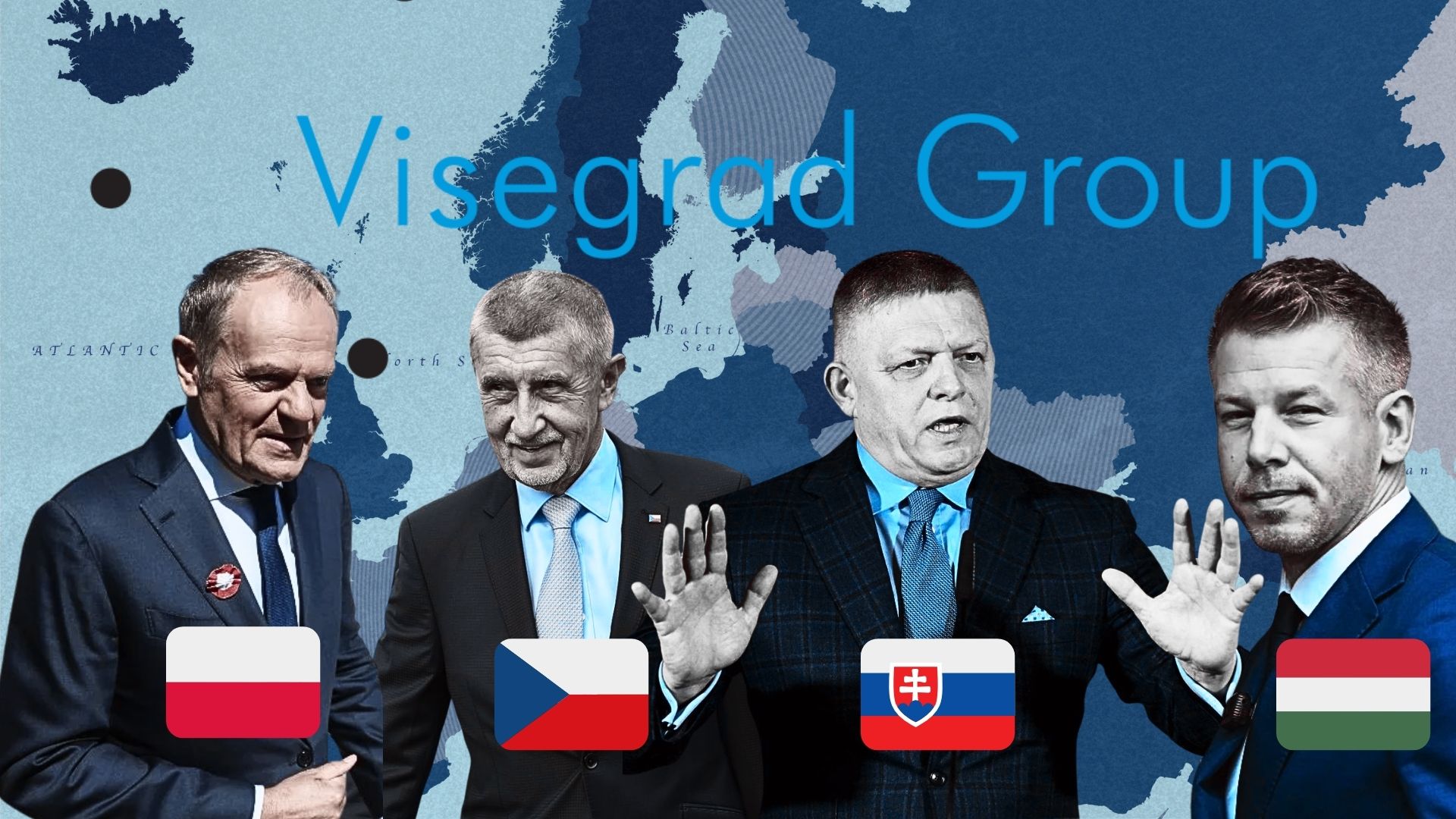
The V4 leaders now eye renewed cooperation with cautious optimism, hoping the group can once again become a force for good. Success will depend on learning from past mistakes and capitalising on opportunities arising from the global turmoil.
Just a week ago Poland’s Prime Minister (PM) Donald Tusk winked ironically as Slovakia’s Robert Fico offered cordial greetings at an EU summit in Cyprus. The moment coincided with Tusk’s pointed comments about removing Russian influence from Brussels – now that Viktor Orbán is no longer in the room. The irony was that Fico was still scheduled to visit Putin on 9 May – the day of Russia’s Victory Day parade boycotted by Western allies.
Yet despite the friction, Fico later posted a selfie with Tusk and Czechia’s Andrej Babiš, captioned in a way that expressed longing for their new Hungarian partner Péter Magyar. Tusk, for his part, gave a lengthy statement suggesting Fico might prove a pragmatic leader capable of overseeing a revival of the Visegrad Group (V4) under Slovakia’s rotating presidency, which begins in July 2026.
Read Tusk’s full statement HERE
After years of obituaries declaring the V4 too dead to revive, is a comeback now underway? And what does the broader game of global economic statecraft – including America’s Energy Dominance strategy – tell us about this Central and Eastern European (CEE) chapter?
Perhaps its revival quietly marks one of the moments where some in Europe, instead of rebelling against the United States (US), which Jacob Kirkegaard from Bruegel called ‘futile’ in his sobering analysis for Foreign Affairs, see an opportunity in embracing it?
The Visegrad Four (V4) leaders may want renewed cooperation, looking at global turbulence with cautious optimism that stems from how they reinforced their position during the past crises. Now they may hope that the V4 group can once again become a force for good – an element of strategic resilience against primarily Russian neoimperial ambitions; and in the longer run – any other neoimperial ambitions aimed at the region.
For such hopes to succeed the V4 leadership must stay true to the course of building energy resilience, a prerequisite of any successful economic security in Europe, and maintaining geostrategic alignment with NATO objectives – regardless of the Trump Administration’s trial-and-error attempts to pull Russia away from China. Ironically, the former is most supported today by US energy investments in the region. The group should also step up its efforts to mobilise the EU towards a more advantageous form of economic statecraft.
Poland’s participation in the G20 format as a member is a status no other country from the region may ever enjoy. If Poland offers its role in the global forum, as the representative of the broader CEE region, it has the potential to strengthen the weight of the V4 as well as the Three Seas Initiative and the Nordic-Baltic Eight on the global stage.
This would stem from quite an exemplary model of economic culture in CEE, that, in the words of one of the region’s key business leaders, remains one of our unique strengths in the world seeking sources of growth closer to home and reduced dependency on adversaries.
Editors’ Pick: Reviving Visegrad Cooperation through 3SI
Poland’s LNG and pipeline system has been reshaped since 2022 into a diversified infrastructure that can well become Europe’s energy supply hub. The Świnoujście LNG terminal, commissioned in 2016 and expanded in 2024, has an annual regasification capacity of about 8.3 billion cubic metres, with utilisation close to 100 per cent, which makes it one of the most heavily used terminals in Europe.
The country’s ambition to become a regional gas distribution hub promises greater energy availability and more competitive prices for its neighbours. The V4 must capitalise on that and play a stronger role in shaping the EU’s approach to economic growth and energy resilience, drawing on its own potential and striking a better balance with dominant players such as France and Germany. As any experienced investor knows, belief in the common political economy potential is the essential first step towards mobilising the full strength of these markets.
The surprise display of friendship by Tusk, Fico and Babiš – and the expectation that Hungary’s incoming prime minister will join them – has turned hopes for revival from surprising to genuinely inspiring.
The Visegrad Group has long been a source of inspiration, irritation and worry for the EU and beyond. It forged its path through coordinated withdrawal of the Red Army, accession to NATO, guiding Slovakia away from authoritarianism into the EU and a unified response to the 2009 Russian gas cut-off that raised the region’s agency on energy security. As Martin Ehl observed in the first edition of Visegrad Insight in 2013, gas would become one of the defining issues for the region’s future.
Successive V4 governments worked to heighten Europe’s geoeconomic awareness of strategic dependencies. They built EU-aligned infrastructure for diversification and connectivity, expanded storage capacity and in 2013 developed a joint energy security agenda to advocate for nuclear power expansion against Germany’s nuclear phase-out. The cautionary tale of centuries in which stronger neighbours overrode CEE political agency appeared to be fading with their EU membership success story. The Three Seas Initiative, building on V4 foundations, has extended this logic across a wider region, positioning CEE as a corridor of growth and interconnection.
The group’s most notable early assertion came in 2014, when it blocked the EU’s initial neomercantilist approach to external migration under Chancellor Merkel – a policy Berlin later adjusted in a quiet U-turn. That was the V4’s ‘baby-project’ phase – a loud ‘no’ marked its arrival as an assertive voice. What followed was a rebellious adolescence that nearly destroyed the trust built over the preceding years.
For more than a decade, the V4 agenda was increasingly defined by Orbán’s approach that included pro-Russian sentiments, lingering dependencies on adversarial resources and political disunity that undermined the group’s collective influence on European politics and economic statecraft.
Even as the V4 continued to lobby successfully for energy security and innovated during COVID-19 through real-time data coordination, deeper problems festered – democratic erosion and crony ties in the energy sector with Russia and China, particularly in Hungary. Internal incoherence eventually shattered cooperation. The once-strong ideological Budapest-Warsaw axis collapsed when Russia’s 2022 invasion exposed strategic divergence.
The link is reviving now, albeit under different slogans and a more forward-looking outlook.
But the revival is not guaranteed. As we wrote, Slovak-Hungarian relations remain strained over the Beneš Decrees and minority issues. Thus, turning to pragmatic foundations is the only window of opportunity the region has to overcome such legacy issues. Energy resilience, deeper EU economic engagement and alignment with NATO principles must remain central.
Poland’s rising weight, along with US-backed energy powering the region, is an important European asset on the global stage. In a period of transatlantic readjustment and Russian diplomatic contraction, a cohesive, forward-looking V4 could help the EU strike a better balance between strategic autonomy and collective strength.
The coming months – beginning with Slovakia’s presidency programme in early July – will reveal whether the Yerevan selfie marks a fleeting photo opportunity or the start of a substantive new chapter. If the new ‘four musketeers’ learn from the past and seize the present opportunities in global economic statecraft, CEE could once again amplify its agency and contribute meaningfully to European security and prosperity.
This text has been reviewed by Arslan Suleymanov and Vitali Matyshau.
Democratic security comes at a price. What is yours?
Subscribe now for full access to expert analysis and policy debate on Central Europe.
Commentary
Democratic Security
Buy American, Build European? CEE’s New Defence Strategy
7 October 2026
Commentary
Democratic Security
The Deafening Silence of Poland in Europe
6 October 2026
Commentary
Democratic Security
Few Reasons to Worry About Latvian Trump
1 October 2026
Economic Security
Think Tank
How Poland Wants to Turn a Failing Train Maker into a Geoeconomic Asset
30 September 2026