

Analysis
Democratic Security
Nawrocki Is Crouching for the 2027 Interregnum
10 August 2026

19 February 2026

The Three Seas Initiative has so far been a presidential framework for enhanced cooperation in Europe. With Poland’s current political cohabitation – when the President and the government are from the opposing camps – it opens space for a reset. If the government does not take the initiative now, it may lose the momentum for good.
Click on the banner to register for our online event
Next week Radosław Sikorski, Poland’s Deputy Prime Minister and Minister of Foreign Affairs will deliver a speech in the Sejm (lower house of parliament) on Poland’s foreign policy priorities. The timing matters because times really have changed and there is no consensus about the direction that the country is taking. Europe’s security and development strategies have so far been defined by the norms and values that challenge hegemonic ambitions – on the continent and elsewhere in the world. But what good are these today if they are not backed by strength – expressed through defence capabilities and economic security toolbox?
Poland is therefore right to double down on alliances with key security partners. But it must also use this opportunity to focus on the North-South corridor, as that is where the European security landscape is shifting most rapidly.
In other words, alongside realising Poland’s potential as one of the Union’s six largest economies, the government should reform the Three Seas Initiative (3SI) so that it helps integrate its southern neighbours with its ‘northern’ perspective on security, democracy and economic growth. Poland’s southern partners – including the Slovaks, Hungarians, and Bulgarians – should see Poland’s proposal for shared connectivity for what it truly is – the infrastructure of the region’s collective economic security. The 3SI should be understood a practical tool for breaking old geopolitical dependencies and clarifying Poland’s strategic national interests
Take, for example, road links with Czechia and public opinion about Poland in the country that is Poland’s second-largest trading partner. Despite sentiments in Poland, Czechs did not hold Poles in high regard (2024 data shows that only about 64 per cent Czechs like Poles, while about 84 per cent of Poles like Czechs) until newly opened highways and new railway connections connected the transport networks, attracting half a million Czech tourists last year, who now speak enthusiastically, even online, about ‘discovering Poland’. The context is important because, alongside the economic dimension, joint investments financed by the EU and national budgets also build social ties and a common understanding of security issues.
And what if new transport and energy links with Hungary had been opened some time ago? How much would new energy routes south and north have helped Hungarian friends to be more resilient than today?
Let us move forward, because Europe does not end at the Danube. The capacity to plan – or to block – new connections is what grants foreign policy concepts their true power, measured by the enduring impact of infrastructural investment. The 3SI countries also include Greece, one of the fastest-growing economies in the EU alongside Poland, and Croatia, a co-initiator of the 3SI, which will hold the presidency in 2026. The ports of these states and their trade and energy links offer the promise of growth in a Europe struggling with economic stagnation.
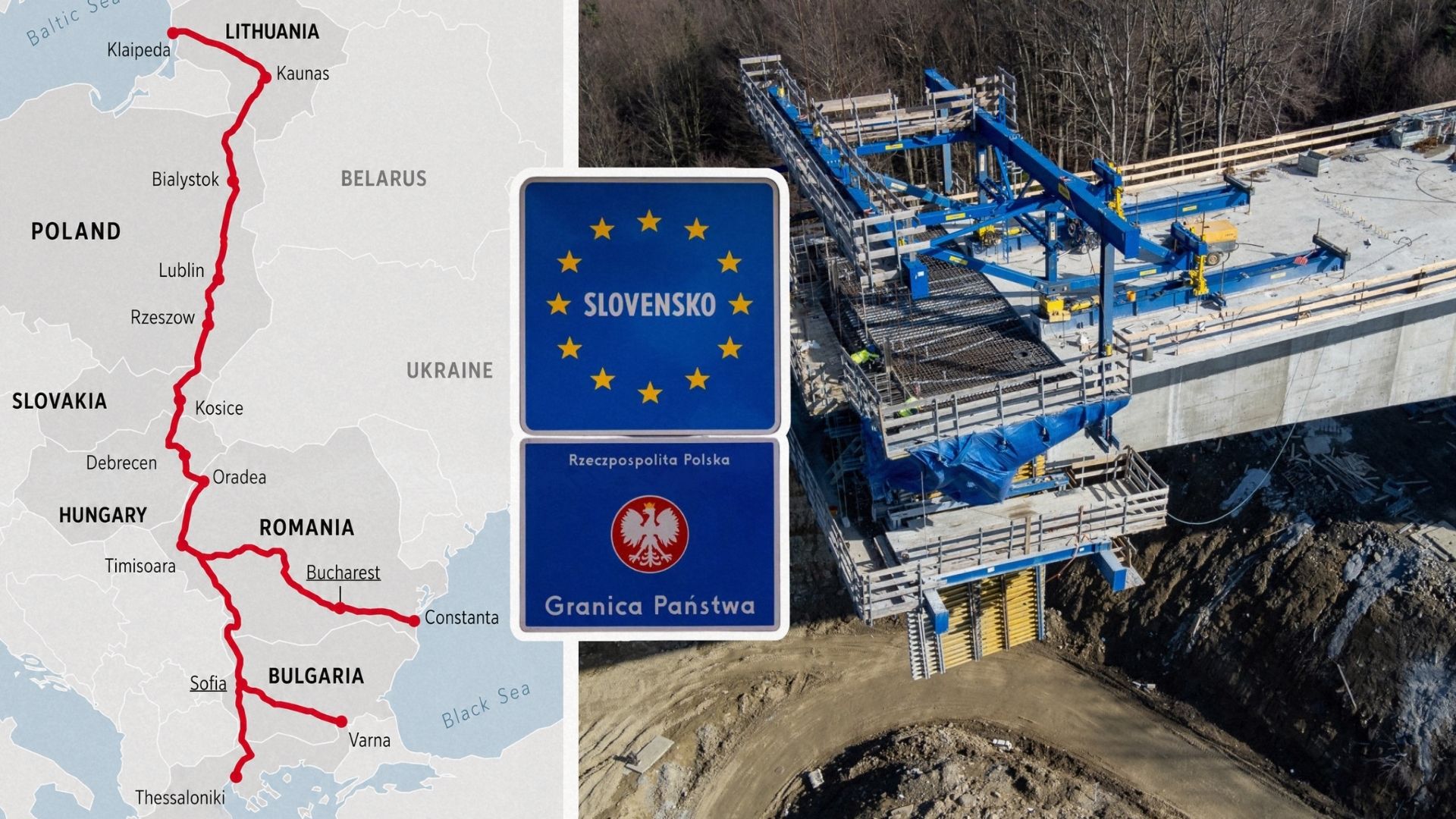
There is still much to do. North-South connections in the region are in disrepair. Military supplies from Warsaw still will not reach Vilnius or Tallinn by rail and exporting goods to Sofia takes twice as long as to Paris, even though the Bulgarian capital is 400 kilometres closer as the crow flies. But it does not have to be this way. Combined with European funding and other projects, such as Rail Baltica, coordination and connectivity between the Three Seas countries have the potential to improve.
The potential of 3SI is also visible in the inflow of investment and dynamic business across the region. Strategically, it is noticed by larger states that look at the CEE region as a set of long-range corridors for trade and security and as safe destinations for state pension funds.

The main goal behind the establishment of 3SI by Poland and Croatia in 2015 was the development of transport, energy and digital infrastructure connecting the countries of Central and Eastern Europe. The Initiative was inspired by the 2014 report by the Atlantic Council and Central Europe Energy Partners called Completing Europe – From the North-South Corridor to Energy, Transportation, and Telecommunications Union, the direction of which stemmed from the achievements of eight PO-PSL governments but, in practice, the idea was introduced into politics by President Andrzej Duda.
Unfortunately, despite the original assumptions, at the early stage some radical circles within the Polish far-right camp distorted the Three Seas idea for the purposes of an anti-German narrative, presenting it as a new version of the neo-imperial Międzymorze (Intermarium) idea or as an alternative to the European Union. Nothing could be further from the truth. This also met with a lack of understanding among the countries invited to the initiative, which made limiting it to European Union member states a condition of their participation.
In the end, the Three Seas format served as a tool in a contest for the attention of the United States (US). Since the presidency of Barack Obama, Washington has shifted its strategic centre of gravity from Europe, seen as a historical burden, towards South-East Asia in response to China’s great-power ambitions.
The ‘new Europe’ region has proven crucial not only for security reasons, as the eastern flank bordering Russia and investing in military capabilities, but also as an attractive and secure market for international pension funds. Not only Americans noticed this. Others did too, which helped push the status of Three Seas sharply upward, a rise that continues.
Last year the European Council on Foreign Relations (ECFR) was urging Giorgia Meloni’s government to join the initiative. This year, the Japan Bank for International Cooperation (JBIC) – Japan’s most important policy-based investment and export credit institution – is opening a representative office in Poland, marking its third presence in the EU after those in London and Paris. It will be focused specifically on cooperation within the 3SI framework. In other words there are more prospects in the future than there were in the past.
So far, the unquestionable political high point was the 3SI summit in Warsaw in 2017, attended by Donald Trump. Despite the anti-EU rhetoric of the US president, the summit also confirmed the initiative’s roots in the region, which led to subsequent 3SI summits hosted by other states. It also confirmed strategic United States engagement, capped by a bipartisan resolution supporting 3SI in 2019 and an announced contribution of up to one billion dollars to the Three Seas Initiative Fund, of which the US ultimately contributed less than 300 million dollars.
The 3SI further secured recognition from the European Commission and Germany. Both acknowledged the initiative’s positive implications for the European Union, marking their support with high-level representation at the 2018 and 2019 summits by Presidents Jean-Claude Juncker and Frank-Walter Steinmeier. This cooperation culminated in the Commission and Germany receiving strategic partner status, joining a group that includes the United States, Japan, Spain, and Turkey.
The 3SI has undergone significant Europeanisation, arguably becoming the EU’s most dynamic macro-region. Equipped with political representation and its own investment capital, it complements the record influx of European funds. Historically, such macro-regions have played a pivotal role in development planning across the Alpine, Adriatic, Baltic, and Danube areas. Through the 3SI, Poland has demonstrated a new calibre of excellence and leadership within the EU.
The change in attitude of the European Commission and Berlin confirmed the validity of the Three Seas Initiative but the pandemic and Russian aggression against Ukraine proved the format’s viability. This period has shown that north-south infrastructure is crucial to the region’s economic security and military mobility. The result was a rise in the initiative’s standing. Ukraine, Moldova, Albania and Montenegro joined as associated members, while Greece, mentioned earlier, has been a full member for three years.
All this demonstrates confidence in the potential of the format led by Poland. The partners know that relations with Warsaw can be their gateway to key capitals in Europe and the world. However, Poland must set clear conditions in return. It has the right to expect a shared security vision and can under no circumstances cede ground to the ambitions of regional autocrats. Viktor Orbán, taking advantage of Warsaw’s earlier weakened position, has dominated the Visegrad Group (V4) but his appetite is larger still. He must not be allowed to similarly hijack or undermine the 3SI. It is too valuable a tool for shaping the future of Europe, which is still a hotly contested issue.
The paradox of Poland’s ‘cohabitation’ between the president and the government becomes clear in the context of the Dubrovnik summit in April 2026. Poland is to be represented there by Karol Nawrocki, supported by the presidential apparatus, while the host will be Andrej Plenković. The Croatian prime minister – an ally of Donald Tusk within the European People’s Party – moved 3SI prerogatives from the presidency to the government back in 2020.
I am not arguing for sidelining the head of state from 3SI. The presidential level remains valuable, not least in relations with the United States. I do, however, note that for the Polish government in particular – this is another test and an opportunity to prove its political case and settle the rivalry over each other’s capabilities in foreign policy.
Three Seas remains a key area of action for the government. It is governments, not presidents, that decide investment budgets. Heads of state look good in ‘family photos’, which was important at the initiative’s inception but has lost its significance over time. Of course, the president’s role does not disappear. If Karol Nawrocki could persuade Donald Trump’s team to unblock funding, it would be an asset. Out of the promised one billion dollars, the United States provided only a third. The government should support the president substantively in this mission, but its strategy must rest on the hard competencies of the Ministry of Foreign Affairs and the Chancellery of the Prime Minister.
An ideal moment for a fresh start is also the debate about the EU budget for 2028 to 2034. This is a field where the countries of the region can work towards one goal in Brussels.
After ten years, 3SI has become part of the regional puzzle, with Poland in the role of leader. Participants’ enthusiasm varies, as does the assessment of what the format delivers. Even so, the main goal, north-south infrastructure, is more important today than ever.
The mixed reviews of the Three Seas Initiative are partly a legacy of the PiS government, which, due to its Euroscepticism, failed to capitalise on the opportunity and often positioned the Initiative in opposition to Brussels. The current government, thanks to its pro-European orientation and strong international position, has the necessary mandate to finally unleash this potential.
There are leaders who deny the values whose demise they themselves are simultaneously wringing their hands over. This may be outrageous, but Poland can also use this moment to solidify the opposite trend – consolidation around security policies – which the country is currently pioneering alongside the countries of northern Europe.
Europe’s new political geometry offers us unique opportunities. Instead of repeating the mistakes of history, Poland can seize the opportunity by combining it with other multilateral formats such as the E6 initiative (bringing together the largest EU economies) or strengthening relations with the Nordic and Baltic states. The more firmly Poland anchors itself towards integration, the better for the country and the entire continent. Poland is acting in accordance with the lessons of history, building its own power and uniting forces with its allies. The strengthening of Poland’s position in intergovernmental initiatives with Germany, France, Great Britain, Italy, the Netherlands, and Spain is an unquestionable achievement. Poland is an indispensable voice within this group, expressing the ambitions of NATO’s eastern flank.
However, this puzzle is missing a key piece: north-south connections, defined precisely by the Three Seas Initiative. To maintain Poland’s position in the West, it must maintain its role as a security and economic keystone for its neighbours. We are all part of a Western system of values, which, despite the crisis, cannot succumb to false prophets. Political leaders come and go, while democratic hopes for security and prosperity do not change as often as capricious presidents.
It will be futile to moralise about the collapse of the world order in Davos, as the Canadian prime minister did. The international order is changing systemically and requires action, not words. From the perspective of states shaped by history, such as Poland, it borders on irony to quote Václav Havel on the ‘power of the powerless’ while simultaneously discussing the potential for economic cooperation with the Communist Party of China. Especially since the international system is wobbling precisely under the weight of China’s asymmetric expansion.
To weather this storm, Poland must cultivate all formats that truly strengthen itself and Europe.
Featured image source: Maciej Margas, Metanowiec LNG – dostawa z USA, CC BY-SA 4.0
Map source: JayCoop, Three Seas Initiative, CC BY-SA 4.0
This article was originally published in Polish by Gazeta Wyborcza.
Democratic security comes at a price. What is yours?
Subscribe now for full access to expert analysis and policy debate on Central Europe.
Analysis
Democratic Security
Nawrocki Is Crouching for the 2027 Interregnum
10 August 2026
Economic Security
Think Tank
Slovakia Partners Up with Poland on Pragmatic Three Seas Initiative
23 July 2026
Commentary
Economic Security
Bulgaria’s Electricity Grid Needs More Grassroots Oversight
23 July 2026
Analysis
Economic Security
V4 and ETS Revision. Unity Despite Split Expectations
17 July 2026