
Analysis
Economic Security
Baltics Shut Down Lukashenka’s Fertiliser Cash Cow
26 March 2026

31 March 2026
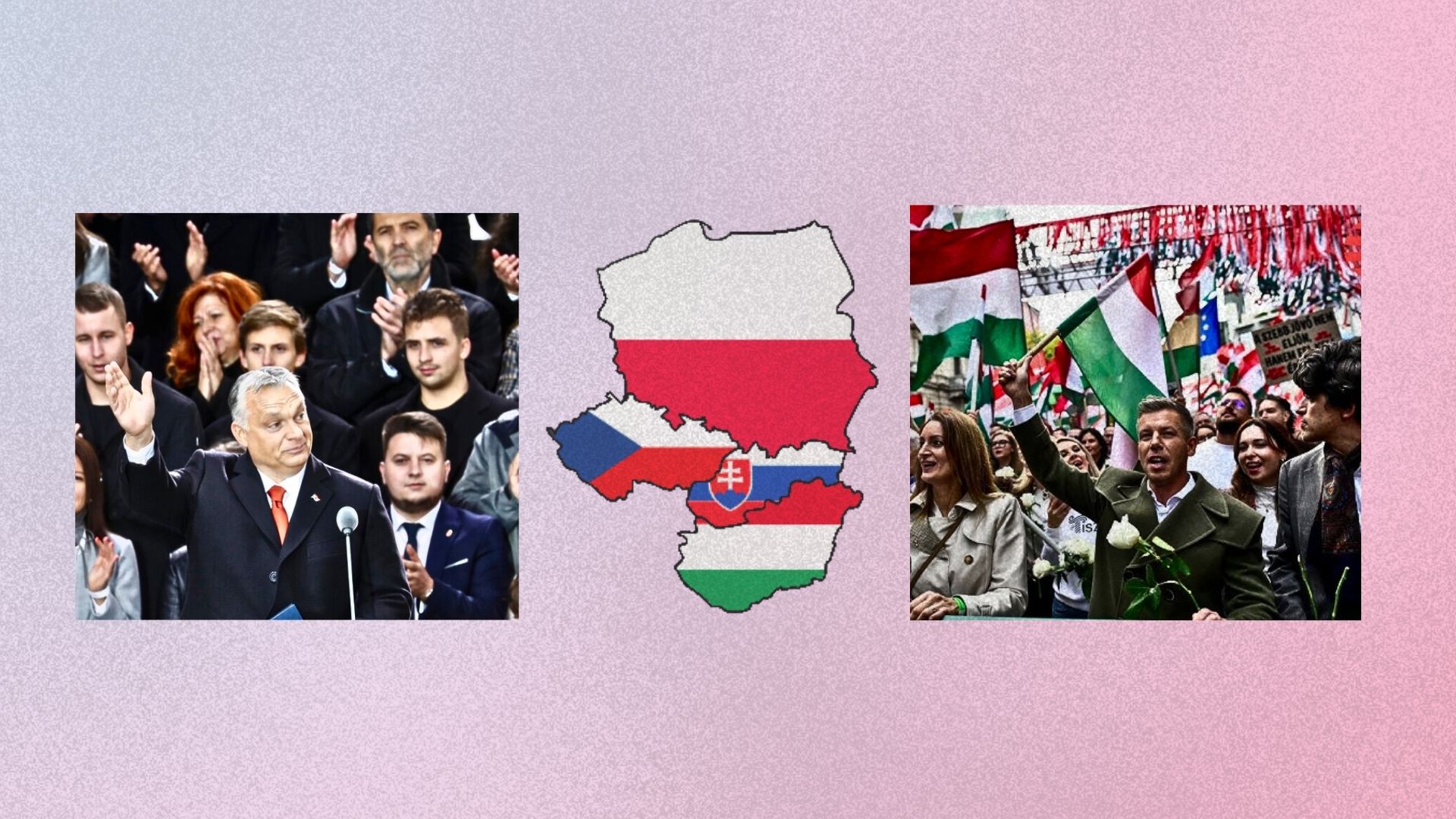
In less than two weeks, Hungarians will go to the polls in a parliamentary election that carries consequences well beyond Budapest. The 12 April 2026 vote will determine not only Hungary’s domestic direction but also the coherence of the Visegrad Four (V4).
The current polling picture is close but opposition-leaning. Aggregated surveys for the elections in Hungary by platforms such as PolitPro and Europe Elects place the main opposition Tisza Party generally in the high-40s per cent range, while the incumbent Fidesz–KDNP alliance sits in the low- to mid-40s. A Medián survey places Tisza ahead with 23 per cent among sure voters – a margin that, under Hungary’s mixed-member electoral system, could translate into a two-thirds parliamentary majority for the opposition, ending 16 years of Fidesz supermajority rule. The far-right Our Homeland (Mi Hazánk) and the Democratic Coalition (DK) both hover around or just above the five per cent threshold.
Against this backdrop, Visegrad Insight spoke with experts across the security, energy and civil society domains to assess what the outcome of the elections in Hungary would mean for V4 cooperation.
A continued Orbán premiership would reinforce Hungary’s pattern of being deprived of or blocking European Union (EU) defence-financing instruments, including the European Peace Facility and future joint-borrowing mechanisms. Budapest remains the only EU member whose major defence investment plan has not been cleared under the Security Action for Europe (SAFE) framework. Hungary has consistently been the opposing voice in a bloc that otherwise supports Kyiv and is wary of the Russian threat.
The cohabitation dynamics in both Czechia and Poland add a further layer of complexity. Czech Prime Minister Andrej Babiš has repeatedly aligned publicly with Orbán and Robert Fico, pledging to end Czech direct budgetary funding for weapons to Ukraine and framing the country’s EU membership as highly distant. Hungarian advisers and media close to Fidesz have openly discussed the idea of a ‘Ukraine-sceptic alliance‘ with Czechia and Slovakia to block further EU funding and military-support packages for Kyiv, framing it as a defence of national budgets and ‘sovereignty’ over foreign policy.
In practice, Babiš has partially walked back his most hard-line positions, notably by agreeing to keep the Czech-led ammunition initiative for Ukraine formally alive while insisting that no additional Czech state money be spent on it.
A Tisza-led government under Péter Magyar would represent a directional shift after the elections in Hungary. Magyar aims to end Hungary’s ‘swing diplomacy’ (aligning both with allies and adversaries), restore the country’s credibility in Euro-Atlantic institutions and rebuild regional cooperation, particularly with Poland – priorities that echo the pro-Western orientation Orbán himself once championed. The distinction is that rather than outright obstruction, the approach promises constructive engagement while retaining the right to defend Hungarian interests.
One significant domestic constraint applies, however. If Magyar’s EU-level positioning is perceived at home as too liberal or left-leaning, it risks alienating the disillusioned Fidesz voters he is seeking to win over.
Anita Orbán, Magyar’s designated foreign policy chief, has ruled out sending Hungarian weapons or troops to Ukraine but has also explicitly rejected the Fidesz-style pro-Russian tilt. In interviews and the party’s foreign-policy platform, she has called for a more consistent pro-Western alignment, including through the V4 framework.
The energy dimension of the elections in Hungary may be the most consequential for V4 cohesion in the near term. In a move framed as retaliation for Ukraine halting Russian oil transit through the Druzhba pipeline, Orbán recently announced that Hungary would stop gas transport to Ukraine, issuing a government decree that makes non-compliance by gas companies subject to financial penalties.
Melinda Zsolt, a researcher focusing on EU energy security, foreign policy and renewable energy transitions with particular attention to Hungary, places the vote within a broader strategic frame. ‘The upcoming parliamentary elections in Hungary can be interpreted, at their core, as a strategic choice between East and West’, she argues, and this ‘broader geopolitical orientation will likely shape not only Hungary’s domestic energy policy but also its role within V4 cooperation’.
Under a continued Fidesz government, Zsolt argues, the Druzhba dispute is unlikely to produce a fundamental change of course. Rather, ‘Hungary will likely seek pragmatic arrangements to maintain flows, even amid political tensions’, reinforcing a pattern in which Hungary’s energy strategy diverges from that of its V4 partners. She warns that Hungary’s ambition to position itself as a regional energy hub built largely on Russian inputs ‘risks deepening not only domestic but also regional dependence on Russian energy’, with V4 cooperation on energy remaining ‘limited and largely transactional’.
A Tisza victory would, by contrast, signal a clear shift. Zsolt describes the opposition’s programme as treating energy as ‘a security issue’, emphasising efficiency, committing to phasing out Russian energy dependence by 2035 and expanding renewables and storage capacity. This alignment with regional and EU-wide trends ‘could help revitalise V4 cooperation through shared infrastructure development, joint energy security strategies, and deeper market integration’. She is careful to note, however, that structural pressures – EU regulation, market dynamics and infrastructure constraints – will push Hungary toward diversification regardless of the outcome, and that ‘the key difference will be the speed and political framing of this transition’.
Andrej Nosko, a visiting researcher at the Faculty of Political Sciences and International Relations at Matej Bel University, is more sceptical about the immediate significance of the Druzhba dispute. He argues that the Hungary–Ukraine spat over the pipeline ‘is much more part of [the] Hungarian ruling party’s electoral campaign, that appears to be built around [an] insinuous Stockholm-syndrome strategy’, and expects the escalation to resolve ‘rather soon after the elections’.
Nosko draws particular attention to Hungary’s strained relations with Croatia, a country ‘key for alternative crude oil transit for both Hungary and Slovakia’, noting that Orbán has not made an official visit to his Croatian counterpart since 2018 – a dynamic he expects to change in the event of regime change in Budapest.
On the broader question of decoupling, Nosko notes that the picture has shifted considerably since early 2026.
Prior to 28 February 2026, he says, ‘the odds of decoupling from Russian energy were fairly strong, with success most likely aligning with the REPowerEU timeline by the end of 2027’. The uncertainty in global crude oil markets, driven by US and Israeli military actions against Iran and the resulting blockade of the Strait of Hormuz, has since raised the cost of decoupling not just for Hungary but across Europe.
With the US temporarily lifting sanctions on both Iranian and Russian oil, Nosko notes that similar policy shifts or discussions may emerge at the EU level. Nevertheless, he points to a potential counterweight – intensified Ukrainian military action may impose de facto ‘kinetic sanctions’ that ‘could undermine Russia’s physical capacity and infrastructure to export energy commodities, regardless of market demand or the formal legal framework or sanctions, at least in the EU direction’.
The outcome of the elections in Hungary will also set the parameters of the V4’s collective position on EU enlargement. A continued Orbán premiership would almost certainly mean Budapest maintains its veto over the opening of Ukraine’s accession negotiations and sustains pressure on EU-funded military aid, using the threat of halting budgets and sanctions packages as a regular bargaining tool. Orbán has framed Ukraine’s EU membership as a direct security risk, arguing that embedding a war-torn state into the Union could drag Hungary into future conflicts and that Kyiv’s eastern borders are not ‘set in stone’, while simultaneously promoting strategic-partnership status as an alternative to full membership.
For the V4, this positions Hungary as the principal brake on any acceleration of Ukraine’s EU path, even as Poland and the Czech Republic remain formally supportive of Kyiv’s candidacy. In practice, Budapest’s stance forces the V4 to coordinate around the lowest common denominator on enlargement – strong support for Western Balkan accession, covering Serbia, Montenegro, North Macedonia, Albania and Bosnia and Herzegovina, but a more cautious and fragmented line on Ukraine. Struggles over Ukraine would increasingly be handled outside the V4 format or in ad hoc groupings with Poland and like-minded states.
A Tisza victory would not automatically convert Hungary into a champion of Ukraine’s fast-track accession, but it would likely end the current government’s explicit anti-Kyiv campaigning and reduce the frequency of Hungary’s blocking of EU-level measures. Tisza’s leadership, including Anita Orbán, frames support for Ukraine as part of broader European solidarity and a precondition for restoring Hungary’s credibility in NATO and the EU, even while ruling out sending Hungarian troops or weapons.
Magyar has also insisted that Hungary would retain its veto on Ukraine’s accelerated EU membership, proposing instead a binding national referendum on Kyiv’s accession. This ‘soft-block’ approach would ease EU-level negotiations compared with Orbán’s outright vetoes, but would still render Hungary’s position on Ukraine’s membership a domestically contested question subject to a referendum, rather than a straightforward alignment with Brussels. Poland and Czechia would continue pushing for a clear, time-bound path for Kyiv, Hungary would insist on domestic-legitimacy safeguards and Slovakia would balance between the two.
Kerry Longhurst, a senior Visegrad Insight fellow, suggests that Magyar’s victory in the elections in Hungary ‘could mark the conclusion of the country’s long-standing bully-boy obstructive stance on multiple EU matters, the rise of a rejuvenated V4, and a more positive attitude toward Ukraine’s potential EU membership’. At the same time, she argues an alternative scenario ‘might drive the EU to explore innovative strategies to marginalise Budapest in an effort to safeguard Ukraine’s future within the EU’.
Even if Magyar secures his seat, however, Longhurst believes that it would be premature to assume that Hungary’s reintegration into V4 will transform the group into a pro-enlargement pro-EU enlargement avant garde. ‘While Ukraine’s path to EU accession may become less obstructed, the V4, even with a more pro-European and less abrasive leader in Budapest, is likely to maintain a rather cautious stance toward’, she says. ‘As and when the EU enlargement momentum advances and candidates open up accession clusters, all V4 states are likely to be very sharply led by their own interests and adopt highly pragmatic ‘firm but fair stances’.
The 12 April vote is not simply a Hungarian domestic contest. Across the security, energy and enlargement dimensions, the election will set the parameters of what V4 cooperation can and cannot achieve for the foreseeable future.
Under either outcome, certain continuities hold. First, the V4 consensus on the Western Balkans will likely remain intact. Second, structural pressures toward energy diversification will persist even if Orban remains in power and the CEE region will eventually be structurally more aligned. Finally, even a Magyar-led Hungary would not be a frictionless Brussels partner and V4 will remain an interesting platform to build new political initiatives for the future of Europe.
The more consequential question is whether the V4 transitions from a framework defined by its lowest common denominator to one capable of coordinated, constructive agency. That depends, in no small part, on what Hungarians decide on 12 April.
Featured illustration uses content elements by Associated Press and DWS News.
Democratic security comes at a price. What is yours?
Subscribe now for full access to expert analysis and policy debate on Central Europe.

Analysis
Economic Security
Baltics Shut Down Lukashenka’s Fertiliser Cash Cow
26 March 2026

Analysis
Democratic Security
V4 Disinformation Playbook Extends to Slovenia
20 March 2026

Commentary
Democratic Security
Ukraine is Nearing Parliamentary Collapse, Not EU Accession
19 March 2026

Analysis
Democratic Security
How Péter Magyar Counters Russian Election Fixers
18 March 2026