Events
Think Tank
How Europe Can Build the Capacity to Act Together
2 October 2026

11 May 2026
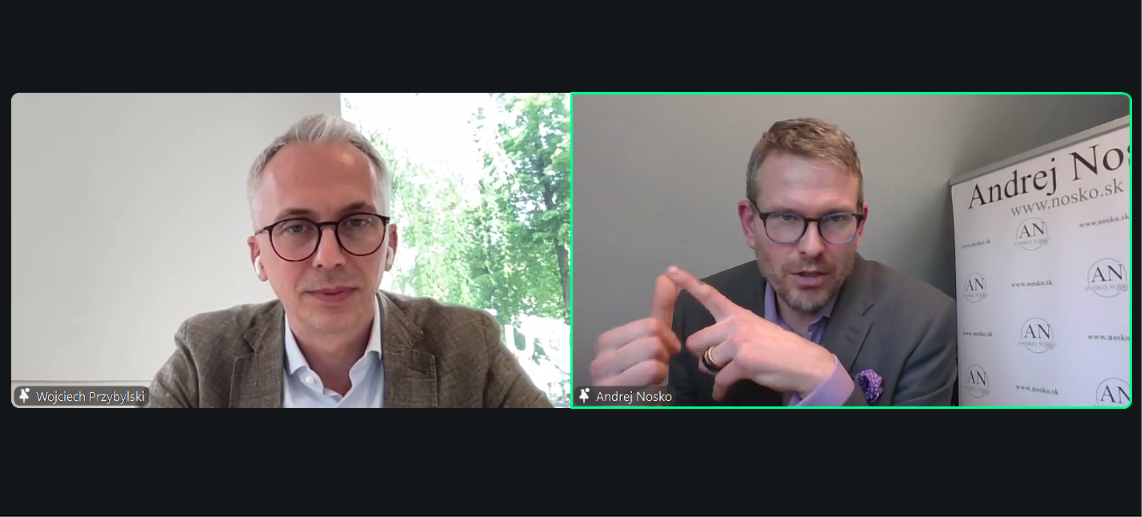
With the Strait of Hormuz crisis entering its third month, Visegrad Insight invited energy expert and a visiting researcher of Matej Bel University Andrej Nosko to examine CEE’s relative resilience and vulnerabilities to the resulting global energy shocks.
Scroll down to watch the recorded part of the discussion.
The discussion partly built upon our editorial analysis – The V4 Economies Weather Off Hormuz Blockade
Despite recent ceasefire efforts and negotiations, none of the proposed resolutions appear durable, projecting a systemic shock across global energy markets. Countries of the region are also vulnerable to shifts in price and supply. However, against this backdrop, the CEE countries have developed a relative strength having rebuilt their system of energy interdependency and some in Poland are even hoping to become one of Europe’s LNG hubs.
Responding to what he called a ‘million-dollar question’ regarding CEE’s relative vulnerability, Nosko argued that the crisis has fundamentally altered Europe’s energy equation. Had the question been asked months earlier, he said, CEE would have appeared considerably more vulnerable than Western Europe due to its dependence on Russian pipeline gas. The fallout from the US-Israeli attack on Iran has, however, upended that calculus.
‘While Slovakia, Hungary and the rest of the region remained worried about exposure to Russian pipeline gas via Ukraine or the Black Sea, the Hormuz crisis has made LNG – long seen as the diversification panacea – one of the sources of vulnerability due to soaring spot prices from curtailed Gulf exports’, our guest noted. This has created a paradox in which Western European economies, more dependent on LNG imports, may now face greater exposure than their CEE counterparts states whose existing pipeline connections to Russia and Central Asia offer alternative supply routes and volumes.
The discussion also highlighted a growing divergence in Europe’s electricity markets. In much of CEE, electricity prices remain closely linked to gas prices, meaning geopolitical shocks rapidly translate into higher consumer and industrial costs. By contrast, the Iberian Peninsula has increasingly decoupled electricity generation from gas-price volatility due to its larger share of renewables.
Against this backdrop, Nosko welcomed recent contracts with the United States and bidirectional gas interconnectors funded as Projects of Common Interest by the European Commission. Poland’s ambitions to become an energy hub – via its Świnoujście and Gdańsk Bay LNG terminals – carry promise, provided Warsaw revises uncompetitive transit tariffs that currently make Polish gas pricier than German routes for Slovak traders.
We shouldn’t equate LNG and piped gas. Even if you have a long‑term contract on LNG, that is a different situation than a long‑term contract on piped gas. You can always find more gas on the market and bring it through LNG infrastructure. The only question is: at what cost?’
‘Whenever I hear a country presenting itself as an energy hub, I can’t help but remember that this was a very common strategy supported from Moscow. It happened to Slovakia, Hungary and many other countries. And even as I am irked by this status now given to Poland by Washington, it has never really translated into a real role, though it has brought some benefits’.
‘What the Hormuz crisis teaches us is that we need to go back to the basics of energy security – not treating any of the major providers as reliable or secure by default, but treating them – especially if they are asymmetrically large – as a vulnerability’.
The discussion also turned to whether Russian gas could one day return to European markets without recreating the monopolistic dependencies that previously distorted both markets and CEE political agency. Andrej Nosko characterised the issue as primarily political rather than technical, arguing that sanctions against Russia have lost much of their leverage following the US military operation in the Middle East, which weakened the economic asymmetry previously underpinning the sanctions regime. With Europe continuing to bear significant economic costs, sustaining both sanctions and a full rejection of Russian energy may become increasingly politically difficult.
As a speculative exercise, however, Nosko suggested that a future arrangement could emerge under radically different conditions. If political questions were resolved and Europe resumed imports from a post-Putin Russia under an international agreement acceptable to Ukraine, the relationship would be ‘completely different’ from the pre-2022 model. Europe’s substantial investment in LNG infrastructure and diversified supply routes would mean that Russia could ‘never again’ regain the dominant market position it once held. Within a diversified portfolio, limited Russian gas imports would represent ‘a much lower security risk’ for EU member states. Such a scenario, however, would require at minimum a durable ceasefire and guarantees that energy infrastructure would no longer be targeted.
The discussion concluded with a cautiously optimistic assessment of renewed regional cooperation within the Visegrad Four framework. Both Przybylski and Nosko pointed to recent diplomatic signals and personnel changes in Hungary as evidence of a possible shift towards more constructive regional engagement. Nosko welcomed the prospect of expanded V4+ format involving Austria, arguing that this may signal a move away from the confrontational posture associated with Viktor Orbán’s government, towards more pragmatic regional projects.
The off-the-record Q&A continued with deeper discussion on Russian transit risks, industrial decarbonisation and the future potential of Visegrad cooperation.
Speakers
Andrej Nosko – Central European energy policy and security expert, visiting researcher at the Faculty of Political Sciences and International Relations of Matej Bel University in Banská Bystrica. His interests include the political economy of security, energy transition, energy policy and security of EU countries and regional cooperation in Central Europe.
Wojciech Przybylski – He leads strategic foresight on EU affairs to improve democratic and economic security in Europe. He chairs EuropeFuture.Forum as the Editor-in-Chief of Visegrad Insight and the President of Res Publica Foundation. Wojciech is also an advisory board member at LSE IDEAS Ratiu Forum, and European Forum of New Ideas.
Democratic security comes at a price. What is yours?
Subscribe now for full access to expert analysis and policy debate on Central Europe.
Events
Think Tank
How Europe Can Build the Capacity to Act Together
2 October 2026
Economic Security
Think Tank
How Poland Wants to Turn a Failing Train Maker into a Geoeconomic Asset
30 September 2026
Commentary
Economic Security
No Endgame in Von Der Leyen’s China Strategy
23 September 2026

Analysis
Economic Security
The Western Balkans Are Ageing Before Getting Rich
9 September 2026