Economic Security
Think Tank
How Poland Wants to Turn a Failing Train Maker into a Geoeconomic Asset
30 September 2026

14 April 2026
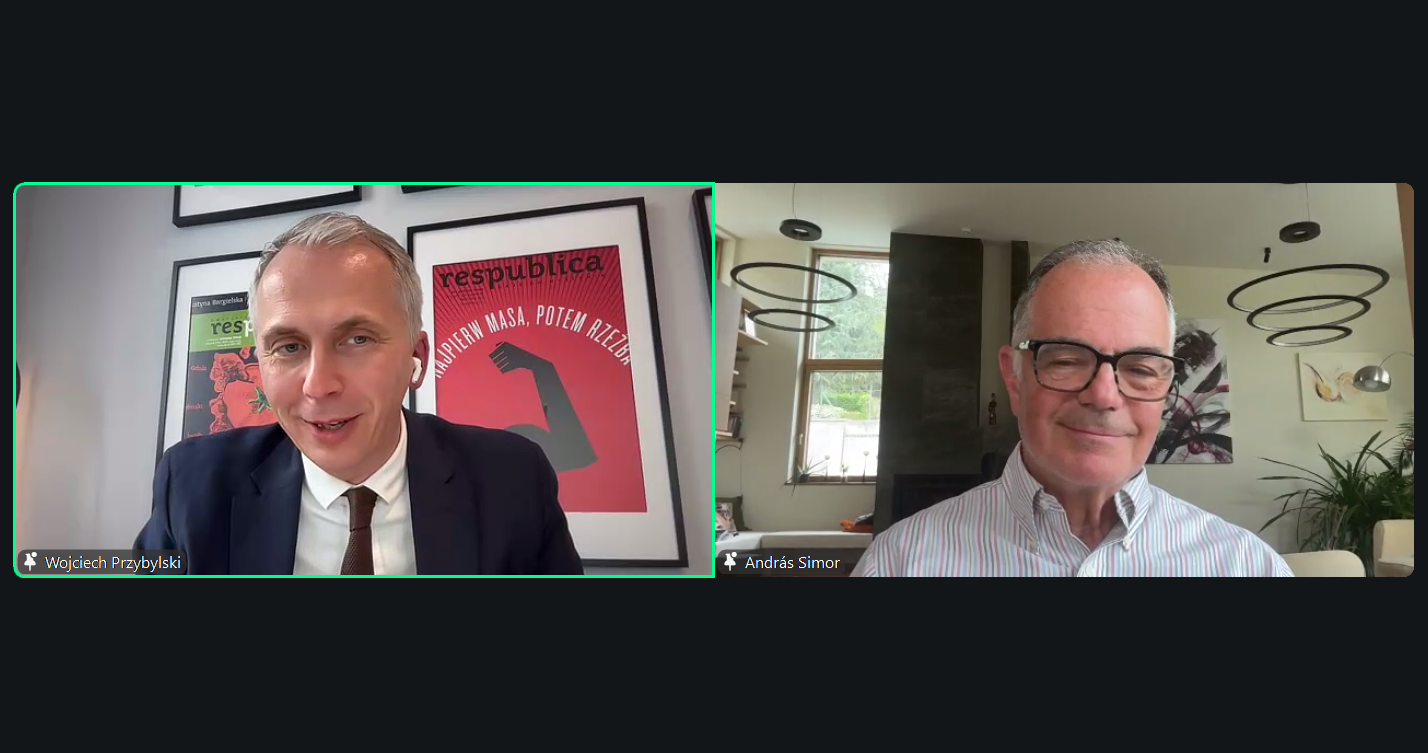
The day after Péter Magyar’s Tisza party secured a two‑thirds supermajority and ended sixteen years of Viktor Orbán’s rule, the event examined what this choice by Hungarian voters means, as well as its political and economic implications.
Scroll down to watch the recorded part of the discussion.
Hungary’s parliamentary election on 12 April 2026 produced a result of historic proportions. Seventy‑seven point eight per cent of eligible voters turned out and cast a ballot – the highest turnout since the country’s first free elections in 1990 – which András Simor witnessed first‑hand as a member of a local voting committee on election day.
With such a high turnout and a mobilised youth vote, Péter Magyar’s Tisza won 138 seats in the 199‑seat National Assembly, surpassing the crucial two‑thirds threshold. Viktor Orbán’s Fidesz–KDNP collapsed to 55 seats, down from 135 seats just four years ago. The discussion framed this result not as a conventional change of government but as a democratic threshold moment – Hungarian society turning away from the choices of the past and choosing something that represents a promise of the future.
The conversation took place the morning after tens of thousands of Hungarians filled the streets of Budapest, chanting ‘Russian go home’ – words last heard so loudly only during the 1956 uprising. The symbolism was not lost on the panel.
András Simor opened with a frank historical observation: ‘Hungary had never fully embraced its democracy, as we did not fight for a change, which fell into our laps in 1990.’ Unlike in Poland or Czechoslovakia, Hungary at the time was relatively comfortable by Eastern Bloc standards and mass mobilisation never materialised, with democratic norms consequently taken for granted by a large part of society. This, he argued, has changed over the past year and culminated in what he described as ‘a win of hope against fear’.
Wojciech Przybylski drew attention to the domestic character of the issues that drove most Hungarians to the polls, first and foremost those of an economic nature. András Simor suggested a structural reason for this – a sharp distinction between Hungary’s current situation and its earlier crises. Previous bouts of instability – current account imbalances, currency pressures and excessive debt – were acute and could be resolved relatively quickly through conventional tools. The present crisis, by contrast, is chronic: a long‑running deterioration of growth, competitiveness, confidence, investment and morale.
He identified three short‑term levers the new government can pull to begin accelerating economic growth. First – eliminating Fidesz’s warmongering rhetoric, as the economy is to a large extent built on expectations, and when people stop fearing war they start spending and investing again, with companies to follow. Second – shifting the philosophy of economic policy by replacing rigged public procurement with genuine market competition, thereby incentivising investment and effort on commercial rather than political grounds. Third – restoring Hungary’s access to frozen European Union funds, which would inject direct stimulus into the economy but will inevitably require meeting the European Commission’s rule‑of‑law conditions.
Moreover, what Hungary needs to increase people’s hope of having a better future, according to András Simor, is dismantling the current status-quo and becoming (again) a fair and just society. He recalled Magyar’s earlier announcement that four senior office-holders must resign – the President, the chief prosecutor, the head of the Constitutional Court and the head of the competition authority – on the grounds that they were appointed to serve as political instruments of Fidesz rather than to perform their functions independently.
The discussion also touched on Tisza’s incoming government team, which will inevitably face a structural challenge. With Fidesz having governed for sixteen consecutive years, most of the public administration is associated with the outgoing regime, and while opportunistic realignment is already under way, Magyar’s team is far from complete and is being recruited partly from the private sector. As several prominent business figures have recently begun publicly distancing themselves from Fidesz and expressing support for Tisza, one of the tests by which the new government will be judged is whether it holds accountable those who cannot credibly change sides. Another challenge is the lack of governing experience: neither Magyar nor most of his closest associates have proven experience in running a country.
On Hungary’s future foreign policy, the discussion noted Magyar’s announced sequence of first foreign trips – Warsaw, Vienna and only then Brussels – which signals his diplomatic priorities: Central European neighbours first, then the wider European Union architecture. Relations with Washington are expected to be cordial but not a priority. The most consequential foreign policy destination and decision, however, is likely to be Ukraine and Hungary’s move to stop blocking European Union financial support for Kyiv.
The discussion closed with a question on Viktor Orbán’s key ally in the EU, Robert Fico, the prime minister of Slovakia, where a shift towards greater pragmatism is now expected as Bratislava has lost its partner in Budapest. Given that Slovakia is a eurozone member with more to lose from rupturing EU relations, and considering Fico’s historically greater caution, a quieter and less obstructionist posture is anticipated rather than a full reversal.
Speakers:
Democratic security comes at a price. What is yours?
Subscribe now for full access to expert analysis and policy debate on Central Europe.
Economic Security
Think Tank
How Poland Wants to Turn a Failing Train Maker into a Geoeconomic Asset
30 September 2026

Economic Security
Events
Think Tank
Europe Aligned with Iran Sanctions Long Before D-Day
8 September 2026
Events
Think Tank
Online event: One Week After Trump’s ‘D-Day’ Against Iran – What Is There for CEE Economic Security?
1 September 2026
Events
Think Tank
European Council Has Fewer Success Stories Than Failures
28 August 2026