Events
Think Tank
Is Europe Preparing for the Right Crisis? Lessons from Finland and the Eastern Flank
15 October 2026

29 October 2026
Treaties oblige Europeans to defend each other, yet true deterrence depends on whether their societies can explain why. How can this play out against existing grievances?

Defence spending and common procurement have been on Europe’s table for years, since 2022. Yet a harder question has received less attention, namely why Europeans would fight at all, and for whom. NATO and EU treaties oblige Germany to defend Poland and Poland to defend Lithuania. Genuine deterrence, however, depends on whether citizens can name their own reasons and whether elected politicians are willing to articulate them. Defence left to the political fringes, or treated as a purely technical file, risks losing that contest by default.
Several questions follow. Why would allies fight for each other? Does it matter what Europe calls its defence model? Are Europeans already at war? And why does the civilian half of defence lag behind the military half, and who will pay to close the gap?
The legal answer is short. Article 5 of the North Atlantic Treaty and the mutual assistance clause in Article 42(7) of the Treaty on European Union bind both countries, and a new Polish-German defence agreement signed on 17 June 2026 reaffirms those commitments. The reasons behind the law are less uniform, and they differ on each side of the Oder.
For Germany, the motive is historical responsibility. ‘It is our historical duty to do so,’ says Lena Düpont, a CDU MEP and the European People’s Party Group coordinator on civil liberties, justice and home affairs. In her reading, the Union is returning to its founding logic. ‘Now we are at the point where we are not trying to provide security for each other within the EU, but with each other towards an external and sometimes not so external threat.’
For Poland, the motive is proximity. Allied obligations come first, followed by the reflex that Poland would be next. ‘The further the aggressor is from our borders, the better for all of us here, whether in Łódź, Białystok or Lublin,’ says Małgorzata Kopka-Piątek, a member of the executive board of the Institute of Public Affairs in Warsaw.
The same logic underpins Germany’s commitment to Lithuania, where its 45th Panzer Brigade is due to reach full operational readiness in 2027 with around 5,000 soldiers and civilian staff. A shared history has not produced a shared memory, however. ‘In the Polish understanding, ‘never again’ means we do not want to be attacked again. In the German understanding, ‘never again’ means we never want to attack again,’ Kopka-Piątek notes.
Beneath both national motives lies a private one. According to research Kopka-Piątek cites, 80 per cent of Poles ready to defend their country in 2023 said they would do so to protect their families, with patriotism and solidarity coming second. Across the region, Visegrad Insight has found starkly different defence postures in the Visegrad Group (V4) societies. Allied obligation matters because private motives alone do not stretch across borders.
It ‘is creating a system of deterrence’, Wojciech Przybylski, editor-in-chief at Visegrad Insight argues, ‘and also this is a system of creating a will to fight in your own society if you know you are backed by your allies’.
One could consider the concept of total defence obsolete and favour comprehensive defence built on whole-of-society and whole-of-government approaches.
Helena Quis, a research fellow on German and European comprehensive defence at European Defence in a New Age think tank, argues that the label should follow national culture. ‘In Germany we do not call it total defence because in German it sounds weird,’ she says. ‘Total defence is a concept as an answer to total war, and as we all know, Germany was on the wrong side of the total war.’
National models need to be not only comparable but also interlinkable, because ‘crises do not stop at borders‘. Finland, which moved from total defence to comprehensive security, remains the benchmark. Düpont favours the Finnish aim of a shockproof society, resilient ‘under constant pressure’, although Resilient Futures Fellow Marta Dermańska has argued that the Finnish model is hard to replicate in full but still useful as a blueprint.
Europeans struggle to name the conflict they are in, and the name shapes how we prepare. ‘When we speak about low-intensity warfare, no tank has been moved yet. But still, we are under pressure,’ Düpont says, pointing to protests that overburden security forces, sabotage and interference with critical infrastructure. The adversary does not distinguish between national targets. ‘Russia sees itself in war with us already, not with Poland individually, not with Lithuania individually, not with Finland or Germany individually.’
Kopka-Piątek treats the missing vocabulary as an honest reflection of a new situation. ‘If experts have a problem saying what kind of war we are in, citizens have all the more right to have that problem,’ she argues. Her practical answer is to prepare for threats in the plural, floods and pandemics included, because recent experience lowers fear and builds habits that would also serve in a military crisis.
Germany and Poland have rebuilt the military half of defence faster than the civilian one. Berlin ran a comprehensive defence system during the Cold War, let it lapse and did not really hear the wake-up call in 2014, when the Nordic and Baltic states began rebuilding theirs. Civil defence entered the agenda only in 2025, when the exemption from Germany’s debt brake was widened to civil defence actors and relief organisations. The two pillars now stand ‘in a sort of imbalance, because the military is going quite ahead, and the civil defence is trying to catch up’. ‘We are getting there bit by bit, way too slow, and without an actual plan,’ Quis warns.
Poland modernised its armed forces earlier, but its civilian side is younger still. ‘In Poland there is no system,’ Kopka-Piątek argues. ‘We also dismantled civil defence.’ The law on civil protection and civil defence has been in force only since 1 January 2025, and it began by transferring military logic to civilian life, ‘focusing very heavily on infrastructure and equipment first and only then on people.
Training first came from the army. This year, organisations such as the Polish Red Cross have begun running courses too, lowering the entry barrier, particularly for women. Public opinion remains caught in the middle. Three-quarters of respondents to a Public Opinion Research Centre survey published this year said they had received the government’s security guide, but only 35 per cent of recipients read it in full or mostly.
The deeper problem lies in where defence sits in government. Defence ‘is looked upon as a technical and a capability and a financial matter, and not as a societal matter enough’, Quis argues of the German case. A military response without a societal one ‘will not work, because the military basically is the society’.
The Nordic and Baltic models cannot simply be copied either. Poland’s model, Przybylski argues, ‘cannot be programmed’. It has to be invented the way Ukraine fights its high-intensity war, through ‘a constant process of adaptation, innovation and inventing one’s role as a society and an economy’.
Reconciliation as preparedness infrastructure
Memory is one of the societal weak spots an adversary exploits, and Polish-German memory is an obvious target. The adversary ‘really capitalises on those facts, really going into the societal weak spots’, Düpont warns. ‘Germany and Poland still need to go through a sometimes painful process of reconciliation,’ she says, one that ‘needs investment, not only money-wise, but also mindset-wise from both sides’.
Polish attitudes are more pragmatic than anti-German rhetoric suggests. Most Poles see the modernisation of the Bundeswehr as support for their own security, and 54 per cent back the stationing of German soldiers in Poland within NATO, against 16 per cent opposed and 30 per cent with no opinion. German soldiers are already deployed in Poland to reinforce NATO’s eastern flank.
The largest asset is the civil society. Decades of reconciliation have produced dense ties between Polish and German municipalities, and those ties have already worked in crises. When floods hit Poland, German partner municipalities called to ask how they could help and offered to host children over the holidays. They did the same when the first Ukrainian refugees arrived.
Preparation of this kind is resource-intensive, and the EU budget is where priorities become visible. The European Commission’s proposal for 2028–2034, worth almost two trillion euros, earmarks 131 billion euros for defence, security and space.
The EU’s comparative advantage lies in preparedness, Düpont argues, through its Preparedness Union Strategy and the Commission’s directorates for civil protection, home affairs and defence industry, and in transferring the risk perception of the Nordic and Baltic states and Poland to the south. ‘There is a bit of a beauty in the toolbox that the EU could actually deploy, if member states allow us to do so.’ Indeed, the European Parliament has made competitiveness and preparedness its priorities, yet the negotiating box under the Irish Council Presidency shows a gap between what member states expect from the EU and what they accept in detail. ‘When you go into the details, everyone is saying, ‘but not like that’,’ Düpont observes.
That diagnosis matches Visegrad Insight’s report Democracies at War. War on Democracies, and it implies that the money must reach society as well as industry. Visegrad Insight has argued that the EU’s preparedness and civil society policies still run in parallel universes. An MFF that funds factories but not municipalities, rescue services and civil society organisations would reproduce at EU level the imbalance Germany and Poland are already trying to correct.
Preparedness is an ongoing process with no clear finish line. In the end, countries must rely on the military capabilities and levels of readiness they actually possess, rather than those they aspire to develop. While solidarity in the face of a crisis may not be in doubt, the greater concern is the time and opportunities lost in preparing, coordinating, communicating and cooperating beforehand. Such efforts should begin at the grassroots level, with stronger connections between neighbours and communities, rather than focusing exclusively on distant strategic challenges.
Defence, meanwhile, is not merely a matter of choice but a constitutional duty. The question is therefore not whether to fight, but what to fight for and how well prepared society will be when the time comes. As Napoleon once said, three-quarters of success in battle depend on the moral character of the army, while only one-quarter depends on its size and equipment.
Germany and Poland now have the treaties, a new bilateral defence agreement and German troops on NATO’s eastern flank. What both still lack is the civilian half of defence, meaning local governments with plans, civil society organisations with budgets, citizens who act on the guidance they receive and a Polish-German dialogue on preparedness that has barely begun. The next EU budget will show whether Europe is willing to pay for that half. Until it does, the reasons to fight for each other exist in law, history and family, and they still have to be built into society.
–
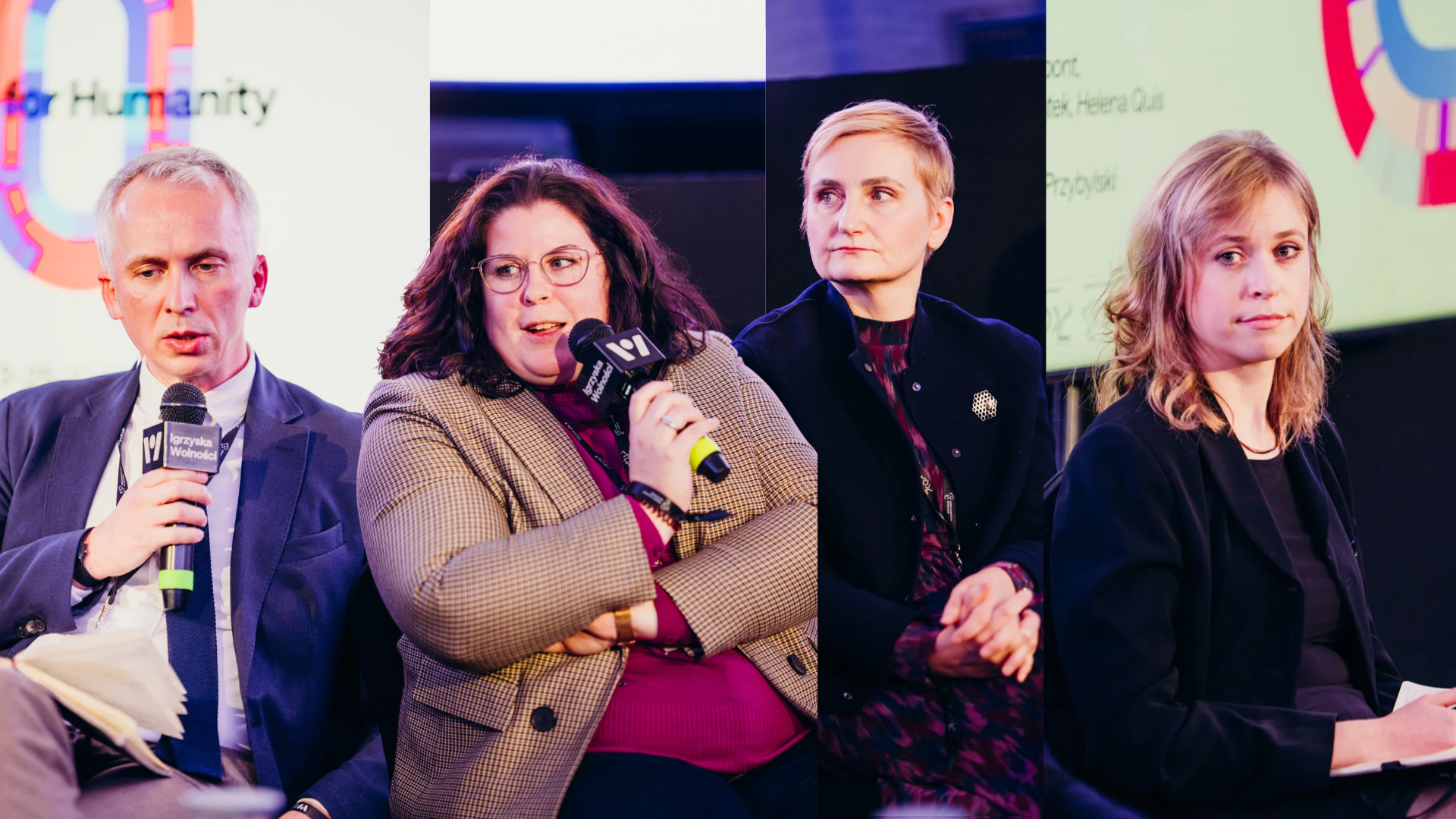
This text draws on the debate ‘European Total Defence: The Role of Poland and Germany’, held at Igrzyska Wolności (Freedom Games) in Łódź on 25 October 2026 and co-hosted by EDINA. Led by Wojciech Przybylski, it brought together Lena Düpont, Małgorzata Kopka-Piątek and Helena Quis. Quotes from Polish-language contributions are the editorial team’s translation, and all quotes have been lightly edited for clarity.
Democratic security comes at a price. What is yours?
Subscribe now for full access to expert analysis and policy debate on Central Europe.
Events
Think Tank
Is Europe Preparing for the Right Crisis? Lessons from Finland and the Eastern Flank
15 October 2026
Think Tank
Visegrad Insight is Hiring!
14 October 2026
Events
Think Tank
How Europe Can Build the Capacity to Act Together
2 October 2026
Economic Security
Think Tank
How Poland Wants to Turn a Failing Train Maker into a Geoeconomic Asset
30 September 2026