Commentary
Economic Security
No Endgame in Von Der Leyen’s China Strategy
23 September 2026

30 September 2026
A development institution rescued a rail manufacturer and made it part of Poland’s geostrategic positioning in Europe and beyond.
Bydgoszcz is a city in northern Poland whose importance runs well beyond its size. In the streets around its main railway station, PESA builds the trains, trams and locomotives that now run across Central and Eastern Europe (CEE). For most of its history the Bydgoszcz works overhauled steam locomotives and freight wagons. PESA became an independent company in 1991, took its present name in 2001 and moved from repairing rolling stock to building it.
Today its managers describe the company in continental terms. ‘PESA today is a European-oriented company, and that is the major difference between PESA and our main competitor in Poland’, one of the executives told a group of journalists and Visegrad Insight Fellows at the PESA plant. That competitor is Newag, a private manufacturer from Nowy Sącz. ‘So now about 50 per cent of our revenues come from Europe’, the executive added.
But PESA’s presence does not end in Europe. Its Ghana contract is the Bydgoszcz manufacturer’s first order in Africa, where Chinese companies have typically taken the lead. The deal, agreed at InnoTrans in Berlin in September 2022, covers two diesel multiple units with an option for 10 more. The trains serve the Tema–Mpakadan line, the first phase of a planned standard-gauge corridor linking the port of Tema with the north of Ghana and eventually Burkina Faso. With the delivery, Africa became the third continent, after Europe and Asia, to receive rail vehicles built in Poland.
The Polish Development Fund (PFR) has owned PESA since 2018, and its long-term investment has contributed to the expansion of Poland’s rail sector abroad.
PESA’s global-looking orientation took a long time to build, and not without pitfalls. In 2012 it signed a framework agreement with Deutsche Bahn for up to 470 diesel units, but only 72 were ever ordered. Certification by Germany’s Federal Railway Authority dragged on for about two years while finished trains stood idle.
In 2013 the Moscow city operator Mosgortrans ordered 120 Fokstrot trams from PESA and its Russian partner Uraltransmash, and deliveries stopped the following year due to EU sanctions against Russia. ‘So just in one moment we have lost 50 million euros of the operation line’, one executive said.
By late 2017 PESA was living on a 200-million-złoty (45.6-million-euro) rescue loan from banks led by PKO Bank Polski. The loan came on the condition that the company found an investor within five months. The Czech manufacturer Škoda Transportation competed with PFR for the company, and executives told us that Chinese firms had also shown interest. By March 2018 PFR had secured the talks.
‘So it was too big to fail’, one of our hosts said, adding that the company was ‘too important for the market’. Choosing PFR was a business decision, a company spokesperson said at the time, but it also reflected a belief that PESA could keep growing on Polish capital.
The rescue fitted a doctrine. Poland’s Strategy for Responsible Development, better known as the Morawiecki Plan, was adopted on 14 February 2017 and named rail among the country’s strategic industries. Under the investment agreement of 17 July 2018, PFR took about 99.8 per cent of the shares and committed 300 million złoty (68.5 million euros)i n fresh capital. Since then it has put in roughly 1.5 billion złoty (342.3 million euros) and converted debt into equity.
The numbers explain why the government decided the company could not be allowed to fail. PESA and its subsidiary in Mińsk Mazowiecki employ almost 4,000 people. More than 1,500 supplier firms, together employing tens of thousands, work with the company. Letting PESA go would have hollowed out a significant regional industrial network.
The state, however, does not intend to hold PESA indefinitely. A PFR representative told us the fund never meant to own the company forever. The options, he said, are a sale or a role in a wider consolidation of the sector, while one executive mentioned a stock-market listing. That raises the question Polish policymakers have so far avoided. Newag now competes against a company backed by the state’s capital and the state’s banks. When state-controlled Orlen ordered new locomotives in 2025, it split the contract evenly between the two, 20 from each.
The most visible part of PESA’s foreign expansion is passenger trains. The Czech Republic is PESA’s most dependable foreign market. A framework agreement signed with České dráhy (Czech Railways) on 26 February 2021 covers up to 160 units worth up to 2.5 billion złoty (570.5 million euros). In 2026 the Czech operator took a 4-billion-koruna (163.9-million-euro) loan from Eurofima, a European rolling stock financier, for 94 regional trains. Of these, 84 are PESA-built diesel units and 10 come from Škoda.
In Romania, PESA beat Alstom in December 2023 to a 223-million-euro contract for 20 electric units, including 15 years of maintenance. In January 2024 it added orders for 62 regional units, taking the potential total towards 4 billion złoty (912.8 million euros). Romania pays for all of this through its EU-funded recovery plan. Much of PESA’s growth in the 3SI region, in other words, rests on European money.
The less visible part of the business may matter more for the region. PESA also builds locomotives. Its Gama Marathon carries a small diesel module that lets an electric locomotive reach sidings without overhead wires, which has made it popular with freight operators.
In January 2026 PESA pushed west. It agreed to buy HeiterBlick, an insolvent Leipzig tram maker, and kept final assembly in Leipzig. Finance Minister Andrzej Domański called the deal ‘economic diplomacy in practice’. He also presented it as an example of Team Poland, the state initiative that pairs government and business to help Polish companies win major markets.
Domański’s words matter because they turn an industrial rescue into an explicit foreign-policy tool. In July 2026 he told Polish ambassadors that the country wants to join the EU’s three largest economies. It must, he said, turn economic strength into a lasting political and negotiating position.
PESA’s most prominent green project is a hydrogen shunting locomotive, the small engine that moves wagons around yards and industrial sites. Its partner is Orlen, which signed a letter of intent with PESA in December 2019 and became the first customer. Orlen planned to use the locomotive at its Płock refinery and to supply the hydrogen. In December 2025 the European Investment Bank (EIB) added about 50 million euros to PESA’s financing package through TechEU, its flagship innovation programme. The loan is meant to fund automation, new zero-emission vehicles and expansion abroad.
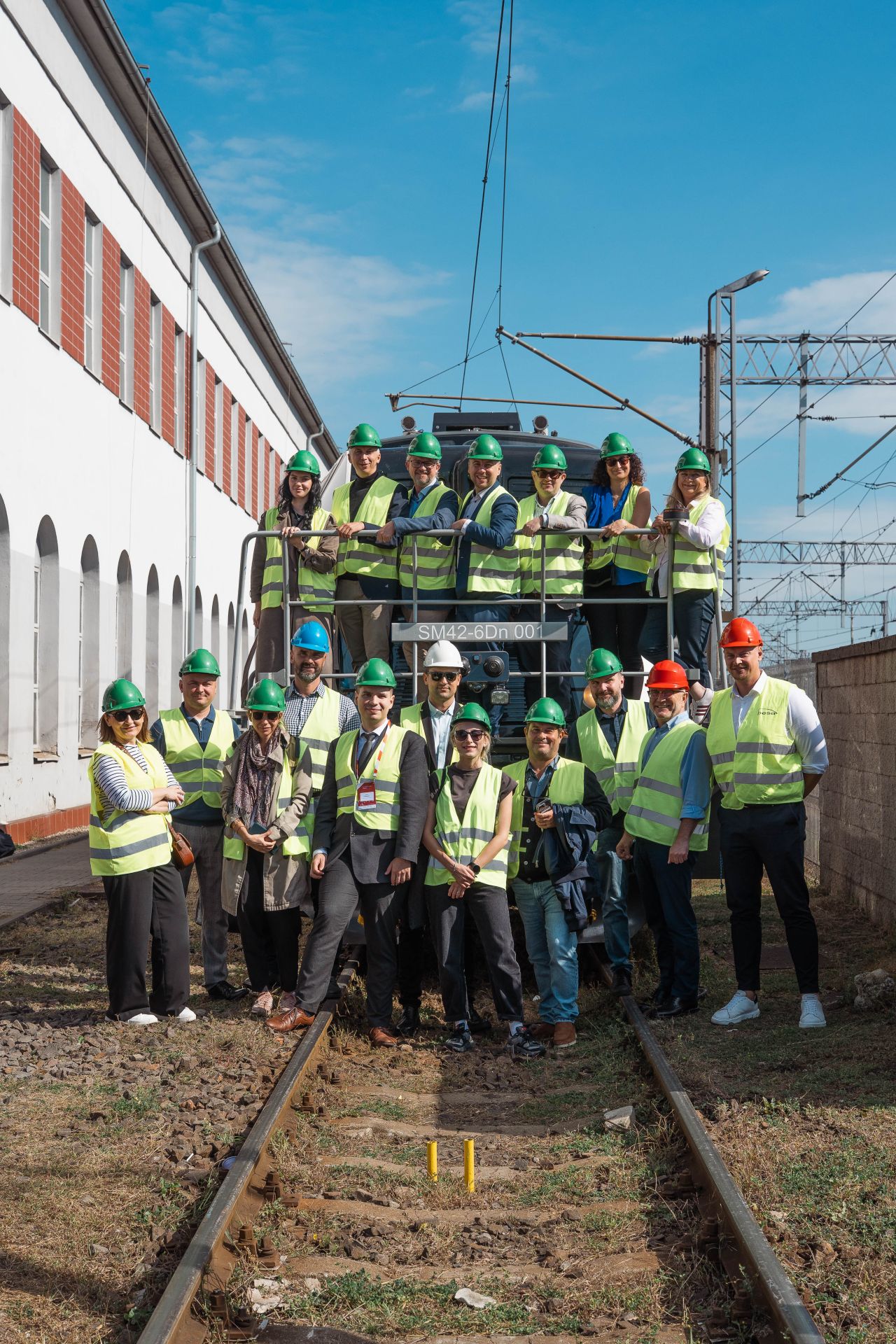
The locomotive itself, the SM42-6Dn, is a rebuilt diesel shunter in which fuel cells turn hydrogen into electricity. Poland’s rail regulator approved it in June 2023, the first hydrogen vehicle cleared to run in Poland. PESA calls it the world’s first certified hydrogen shunter.
Three years later, however, it is still not a commercial product, for several reasons. The machine remains essentially a prototype. Hydrogen is expensive. Refuelling infrastructure barely exists. The rules were not written for hydrogen either, and Polish and European regulations contained no requirements for hydrogen rail vehicles when the locomotive was approved. This delay caused the comparative advantage to deplete, allowing European competitors, such as Alstom orSiemens, catch up and have their hydrogen locomotives on the market by now.
Rivalry with China, in PESA’s case, is concrete. Remarkably, however, it aids Poland’s rail sector, and not without help from Brussels.
PESA and Chinese state-owned CRRC, the world’s largest rolling stock manufacturer, meet in public tenders in the EU and on its periphery. CRRC was one of the bidders in the Bulgarian tender PESA eventually lost to Alstom. In 2018, by the executives’ account, Chinese firms were among the companies interested in buying PESA itself.
Much of the relationship, however, is non-rivalry, because the two companies are not in the same league. CRRC reported revenue of 273 billion yuan (35.8 billion euros) in 2025 and spent 17.6 billion yuan (2.3 billion euros) on research and development alone. PESA cannot beat CRRC on scale or price, and it does not try to compete in China or across the developing world. Its key real advantage is being inside the EU.
That advantage has been given teeth by the EU’s Foreign Subsidies Regulation (FSR), in force since July 2023. The regulation lets the European Commission investigate subsidies from governments outside the EU, including when their recipients bid for public contracts.
The first test came in Bulgaria in 2024. A CRRC subsidiary bid 607 million lev (310.4 million euros) for a set of passenger trains against Talgo’s 1.22 billion lev (623.8 million euros). When the Commission opened an in-depth investigation, CRRC withdrew and the contract went to the Spanish firm.
In April 2026 the Commission let Lisbon’s metro proceed with its Violet Line light rail contract only after the winning consortium agreed to replace CRRC with PESA. CRRC had received around 471 million euros in Chinese government grants in the three years before the bid. The Commission found that PESA had received no distortive foreign subsidies. It was the first conditional decision of its kind under the regulation.
The irony is hard to miss. PESA is owned by a state fund that has put about 1.5 billion złoty (342.3 million euros) into it and is financed by banks and guarantees assembled with state backing. Yet it passed the test, because the FSR only examines subsidies from outside the EU, while money from Warsaw falls under the EU’s separate state-aid rules. Europe’s defences against Chinese overcapacity have become a commercial opening for a Polish state-owned company. Poland, in effect, is practising a milder version of the state capitalism Brussels accuses Beijing of. That is legal, but it weakens any Polish claim to be defending open markets.
The timing of the rescue adds another layer. When PESA was up for sale in 2018, the EU had no common framework for screening foreign investment, which applied only from October 2020, and no FSR. State ownership was arguably the most direct tool Warsaw had to decide who would control one of the country’s two major train makers.
The shield also has limits. It stops at the EU border, so in Serbia and the rest of the Western Balkans, one of PESA’s target regions, CRRC can compete without it. It also works only if a European manufacturer can step in on time. When Brussels removes a subsidised Chinese bid, the contract goes to whoever has the capacity to deliver, as Talgo’s Bulgarian win showed.
For Poland, the lesson is less flattering than the official story. Brussels can close the door to subsidised Chinese competition. Only faster factories, patient financing and approvals in foreign markets can turn that opening into Polish contracts, and on each of these PESA still has a long way to go.
On the final day of the Europe Future Forum Visegrad Insight and the PFR brought journalists from the leading regional titles to the PESA plant to see the inside of Poland’s rail sector and the role it plays in shaping the country’s strategic positioning in the EU.
Democratic security comes at a price. What is yours?
Subscribe now for full access to expert analysis and policy debate on Central Europe.
Commentary
Economic Security
No Endgame in Von Der Leyen’s China Strategy
23 September 2026

Analysis
Economic Security
The Western Balkans Are Ageing Before Getting Rich
9 September 2026

Economic Security
Events
Think Tank
Europe Aligned with Iran Sanctions Long Before D-Day
8 September 2026

Events
Think Tank
Online event: One Week After Trump’s ‘D-Day’ Against Iran – What Is There for CEE Economic Security?
1 September 2026