
Democratic Security
Those Who Do Not Learn from This War Risk Losing the Next – Radosław Sikorski
17 September 2026

5 March 2026
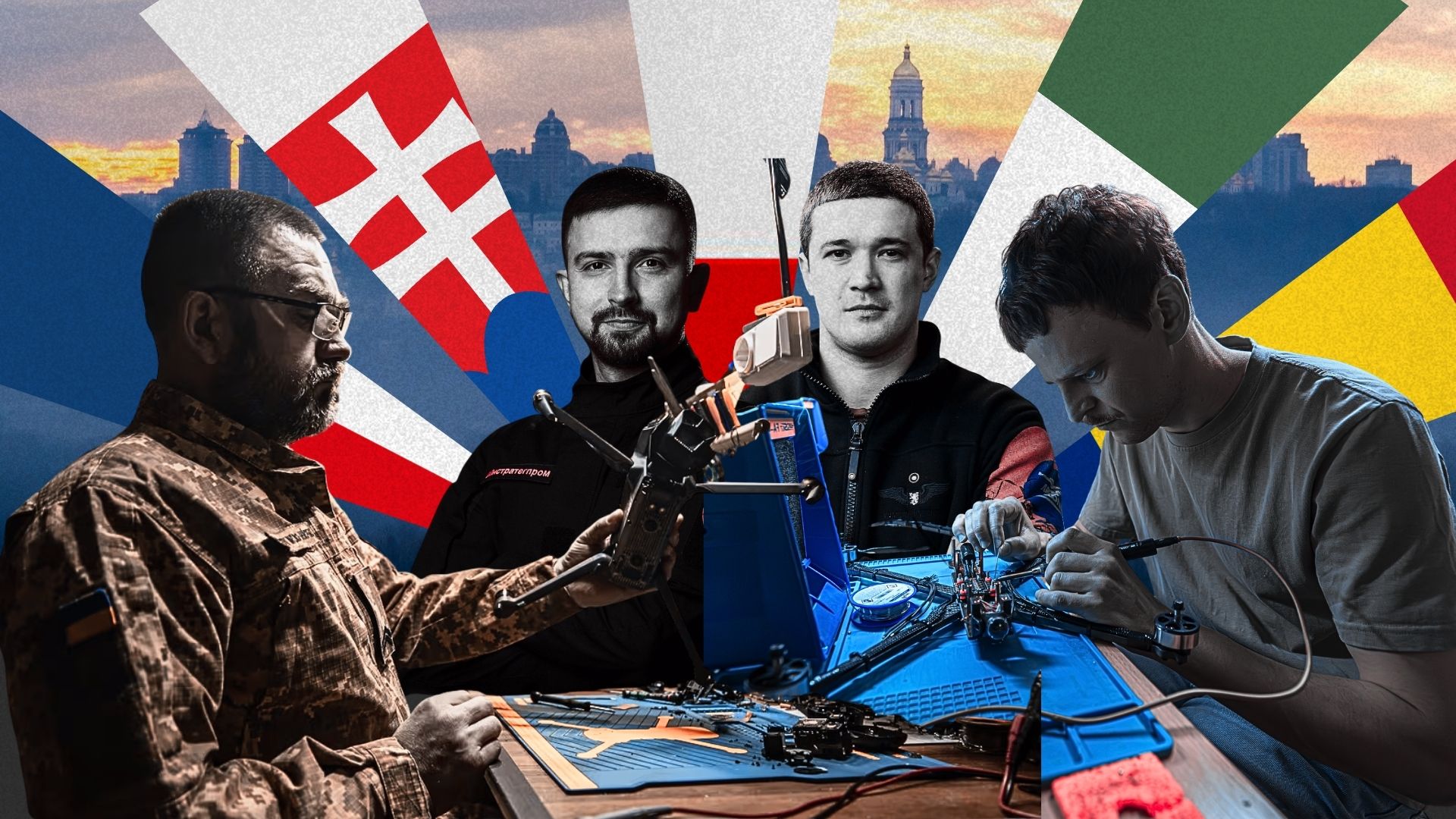
As the CEE region will get the greatest slice of the pie from EU’s 150 billion defence modernisation plan, Ukraine’s defence sector has grown by 350 per cent since 2022. While some in the V4 realise the opportunity, a fog of restraint still remains.

Throughout the protracted high-intensity war that has entered its fifth year, Ukraine has developed an agile defence-industrial complex that helps the country survive in a war of attrition against a major adversary – and build a competitive advantage among its like-minded allies. President Volodymyr Zelenskyy’s announcement of potential assistance to the Middle Eastern countries against the Iranian drone attacks manifested the temptation.
The three major incentives that trigger the defence-industrial cooperation of allies with Ukraine are capacity and agility, an innovative edge and the development of cutting-edge technologies in key areas for future land, air and naval warfare. This includes drones, sensors, missile technology, air defence, asymmetric naval A2/AD capabilities, automation and AI.
Ukraine’s defence-industrial sector produces nearly 60 per cent of the military equipment used by its armed forces. Most of its current 500 defence companies are private entities – ‘garage startups’ that keep redefining modern defence. Excess production capacity in certain areas reaches 45 per cent, offering expertise and production capacity much needed by the allies as well.
The circumstances of war and the real cost of failure measured in lives contributed to building the full defence innovation cycle – experimentation, design, test, trial, production, adaptation and further development – at a scale that European armed forces and defence industries have never had since 1945.
Four years of grinding combat forced the military industrial complex to provide the armed forces with rapidly fielded and continuously adaptable assets. Initiatives such as the Brave1 defence tech platform, Defence City – the regulatory regime aimed at accelerating domestic defence manufacturing in Ukraine and Test in Ukraine, which connects Ukrainian firms to Western investors and trial weapons in live combat conditions – serve these goals.
By integrating Ukraine’s industrial capabilities into European supply chains, the EU could rapidly expand production volumes, diversify suppliers and reduce strategic dependencies in priority areas identified by the Defence Readiness Roadmap 2030. Such technologies include stand-off weapons like the FP-5 Flamingo ground-launched cruise missile, the An-196 Liutyi long-range strike drone, the Long Neptune cruise missile and the 1KR1 Sapsan ballistic missile.
Therefore, promoting investment in Ukraine’s military industrial complex, the establishment of joint ventures and the localisation of European defence production in Ukraine has solid foundations. No surprise that as of February 2026 15 EU member states – including those from Visegrad Group (V4) and wider CEE – have included joint projects with Ukraine in their defence modernisation plans. Already in 2025 Lithuania announced the joint production of drones and acoustic drone detection systems with Ukraine. Poland followed the lead.
As Herman Smetanin, Ukraine’s minister of strategic industries, noted to Ukrinform:
‘Ukraine’s defence industry has proven its resilience under fire… We must fully integrate Ukraine’s defence sector into the European defence technology and industrial base, including involvement in the Rearm EU programme. Joint research and production, joint supply chains, and training of Ukrainian forces will not only help Ukraine win. This will be a victory for the European Union. So, let’s build the arsenal of the free world together.’
Recently, Ukraine has seen a renewed focus on digitisation and a high-tech boost in Ukraine’s armed forces and defence-industrial management, with Mykhailo Fedorov appointed as minister of defence in January 2026. Beyond furthering the digital transformation of the armed forces and creating a unified digital system for all drone operations in Ukraine, development areas for the immediate future also include unmanned ground vehicles and counter-drone laser weaponry.
The Security Action for Europe (SAFE) is the EU’s 150-billion-euro loan initiative designed to accelerate joint defence procurement and strengthen the industrial base to address critical capability gaps, reduce fragmentation in defence-industrial procurement and enhance security, particularly in response to the Russia–Ukraine war. It is yet another incentive for European countries not only to continue but to further deepen their defence cooperation with Ukraine, and CEE countries have already capitalised on that.
SAFE focus areas include ammunition, missiles, artillery systems, ground combat capabilities, critical infrastructure protection, cyber and military mobility in Tier-1, as well as air and missile defence, maritime/underwater systems, drones and anti-drone systems, strategic enablers (e.g., airlift, air-to-air refuelling), space assets, artificial intelligence and electronic warfare capabilities in Tier-2.
As of February 23, the European Council has formally adopted financial assistance for 16 EU member states out of 19 applicants for SAFE funds across two waves, following positive assessments by the European Commission of their national defence investment plans. Poland, Czechia and Romania will use these funds for joint initiatives with Ukraine, while Hungary and Slovakia practice traditional restraint.
Among European countries, Poland is likely to have the most elaborate and complex defence cooperation framework with Ukraine.
At the second wave of funding, it became the largest recipient of the loan, accounting for almost 44 billion euros. Romania, Lithuania and Latvia are in the top-5, while Hungary’s allocation decision is still pending due to the rule of law issues.
Following the security agreement signed in 2024, Polish Prime Minister Donald Tusk announced the signing of a letter of intent aimed at removing technology exchange barriers, securing funding via EU SAFE programmes and establishing joint production of weapons and ammunition at facilities in both countries, during his visit to Kyiv on 5 February 2026. This step, along with a potential industrial credit scheme to be established in the first half of 2026 for Ukrainian and joint defence firms, will pave the way for channelling SAFE funds to the enhanced cooperation in the coming years.
Importantly, instead of direct procurement frameworks, Poland and Ukraine are already establishing joint ventures between state-owned and private enterprises from both countries in the following areas:
Some projects are already operational: Poland’s UNIMOT and PZLD jointly produce drones and anti-drone interceptors with Ukrainian defence companies, while WB Group produces the FlyEye reconnaissance drone in Ukraine.
Important input for the innovation cycle within armaments and services development is provided by the Joint Analysis, Training and Education (JATEC) Centre that operates in Poland to integrate Ukrainian battlefield experience with NATO standards.
Through such initiatives, Poland has become the role model in Central and Eastern Europe (CEE) – not only for supporting Ukraine, but also for engaging with the Ukrainian defence industry in depth.
Czech defence companies do not operate in a particularly supportive domestic environment that would encourage deeper engagement with Ukraine’s military-industrial complex, whether by providing additional resources or by helping to mitigate liabilities and potential risks. Still, private interest and market demand had resulted in programmes that deliver and have potential for the future as well, even as the acceptance of Czechia’s SAFE plan is still pending and its content remains undisclosed.
Despite the substantial support provided to Ukraine via the Ammunition Initiative and various armaments programmes, compared to Poland and Romania, the ‘Czech model’ has remained less elaborate, rather focusing on arms sales and subcontracting than on joint production. As the political support was somewhat weaker and the defence industry mostly relies on private businesses, no general government-to-government framework agreements have been adopted.
In 2022 the Czech Agency for Intergovernmental Defence Cooperation (AMOS), which belongs to the Czech Ministry of Defence and acts as a coordinator of the Czech defence-industrial cluster, signed a Memorandum of Understanding (MoU) with Ukrainian state defence conglomerate Ukroboronprom on creating a joint defence cluster. Yet to this day, this has served as the general policy framework rather than institutionalised bilateral structures. Based on this MoU, Czechia’s state-owned VOP CZ and Ukroboronprom began cooperation on repairing Ukrainian heavy military equipment in Czechia in 2023, for example. Additional projects also exist, including cooperation on drone and small arms production.
Defence-industrial cooperation is mostly centred around ammunitions and artillery shells, as the main products of Czech arms manufacturers sold to Ukraine. External funding – such as SAFE – can be used to expand manufacturing capabilities in Ukraine, thus further reducing production costs, while providing Ukraine with vitally important equipment. For example, Czechoslovak Group (CSG) works with Ukrainska Bronetechnika, relying on it as a subcontractor, whose Ukraine-based facilities can be used for localised production.
Signed in 2024, the bilateral security cooperation agreement between Romania and Ukraine brings intelligence sharing, cybersecurity cooperation and the strengthening of Black Sea security. It also includes the large-scale production of ammunition for Ukraine, serving as a crucial maintenance and training hub for Ukrainian F-16 pilots and supporting the logistical transit of military aid, among others.
Along these lines, Romania and Ukraine have been deepening defence-industrial cooperation for years, focusing on the joint development, testing and production of drones and long-range unmanned aerial vehicles, as well as maritime drone solutions.
Another pillar of cooperation has been the repair and maintenance of Ukrainian armoured vehicles in Romanian territory, for which even Rheinmetall – Europe’s leading arms industry producer – expanded its presence in Romania.
Although Robert Fico, who returned as Slovakia’s prime minister in 2023, has opposed official government-to-government military support for Ukraine, Slovakia has provided fifteen support packages since 2022. These focused on non-lethal, specialised equipment (like the Božena 5 demining vehicles), but also included defence equipment (155 mm ammunition) and arms (Zuzana 2 self-propelled howitzers). Some Slovak companies, including ZVS Holding, are key manufacturers of 155mm ammunition for Ukraine, aiming at boosting cooperation further on a commercial basis and localising the production of ammunition and demining vehicles through joint ventures in Ukraine.
Meanwhile, the Hungarian government has refused both direct military support to Ukraine and engagement with Ukraine’s defence industry throughout the years. Early reasons for the political conflict referred to curbing minority rights for ethnic Hungarians living in Zakarpattia Oblast in Ukraine after 2015, as a fallout from the deepening Russia–Ukraine conflict. Later, objections and allegations transformed to include the agricultural impact of Ukraine’s future EU accession, the ‘spill-over of Ukrainian mafia to Hungary’, being ‘dragged into the war’, and lately, energy security concerns.
These have prevented any meaningful defence-industrial cooperation so far; thus, the country’s SAFE plans seem not to include cooperative projects with Ukraine either. Missed opportunities include ammunition production, the testing and development of the Lynx infantry fighting vehicle and drone production, all of which are at the forefront of Hungary’s ongoing defence industry development.
Questions regarding domestic politics (diverging planning priorities, lack of trust) and economic resources (support to Ukraine, rearmament and modernisation for national armed forces from loans) across the V4 countries have repeatedly become obstacles in the way of deepening and streamlining cooperation with Ukraine’s military industrial complex – see the fluctuations in the level and content of Czech and Slovak cooperation over the years or the Hungarian abstention.
Additionally, some known unknowns within Ukraine might complicate calculations: the prospects of the war; a potential settlement that could even limit Ukrainian resources, armed capabilities and defence industry; transparency and concerns with corruption, weak oversight mechanisms and accountability in the defence sector; the ban on the export of Ukrainian-made defence equipment that is in effect; as well as third party export controls and intellectual property rights.
Further key vulnerabilities include weak supplier vetting processes, contradictions within export-control regulations and occasional political interference or vested interests within defence-industrial value chains.
Democratic security comes at a price. What is yours?
Subscribe now for full access to expert analysis and policy debate on Central Europe.
Democratic Security
Those Who Do Not Learn from This War Risk Losing the Next – Radosław Sikorski
17 September 2026
Democratic Security
Survey
Unlocked
What the European Security Strategy Should Be About?
10 September 2026

Analysis
Economic Security
The Western Balkans Are Ageing Before Getting Rich
9 September 2026

Analysis
Democratic Security
Unlocked
A Polish Crypto Rescue Priced on Orbán Staying in Power
9 September 2026