Commentary
Democratic Security
Few Reasons to Worry About Latvian Trump
1 October 2026

19 May 2026
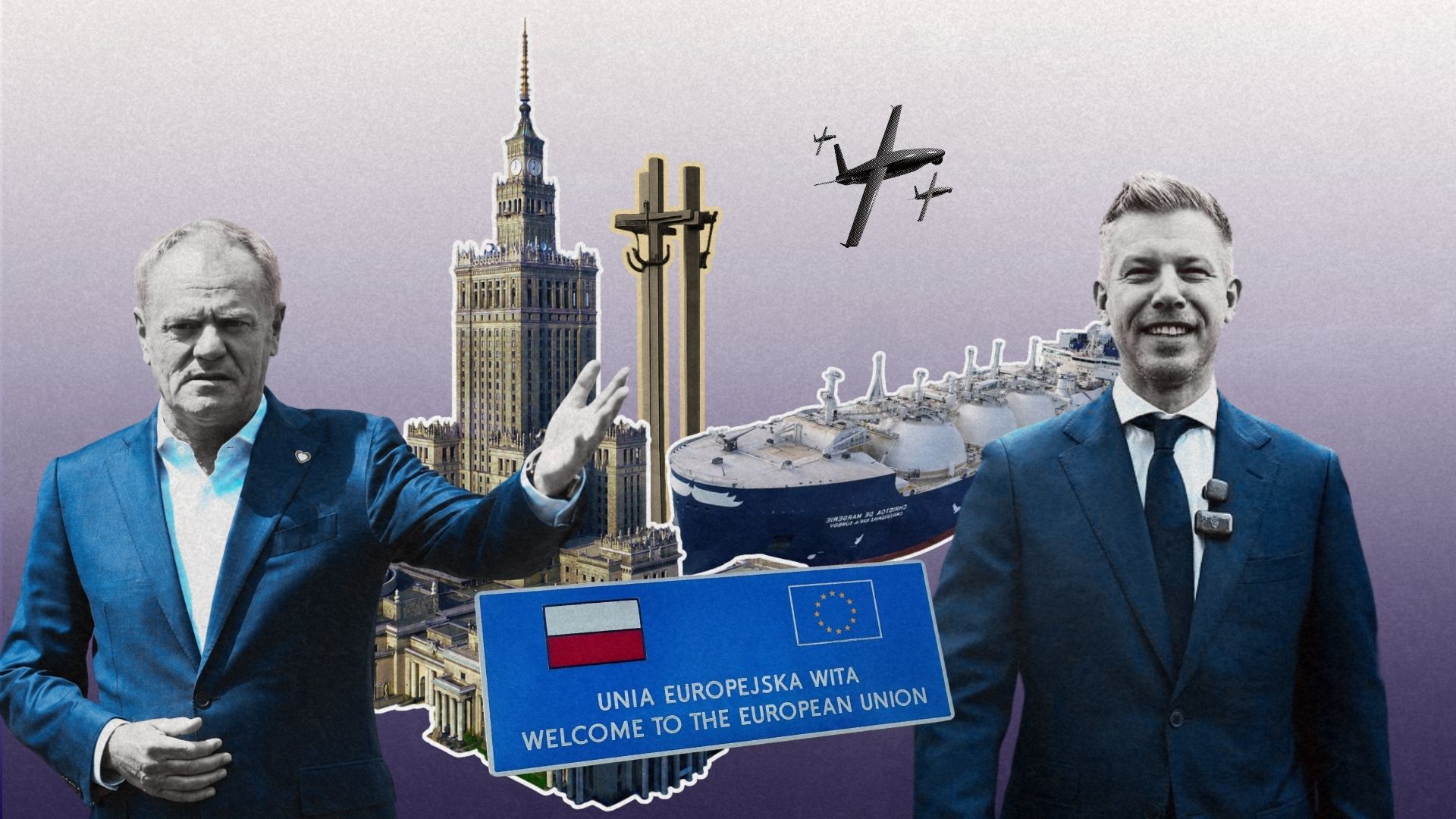
Budapest-Warsaw relations go north, quite literally. Here is what both sides are about to discuss and what will be the ultimate benchmark of future relations between the two countries and of the Visegrad Four (V4) format.

Prime Minister Péter Magyar’s visit to Poland alone will not repair the damage done to the bilateral trust and the once powerful V4. In the past, consistency of political objectives between Warsaw and Budapest enabled coordinated influence on the EU agenda, first when leaders in both capitals belonged to the European People’s Party.
Later, when the capitals turned to become prodigal sons of the EU project, the Budapest-Warsaw axis was ultimately broken beyond repair in 2022. Now the hopes are high again.
The delegation is set to visit Kraków on Tuesday focusing on religious culture programmes, then travel by train to Warsaw for political meetings and follow on to Gdańsk to pay tribute to Solidarity heroes, while likely inspecting the onshore and offshore energy security infrastructure.
Magyar will be accompanied on this trip by his deputy, the Foreign Minister Anita Orbán, Minister of Economy and Energy István Kapitány, Minister of National Defense Romulusz Ruszin-Szendi, Minister of Agriculture and Food Management Szabolcs Bóna, Minister of Transport and Investment Dávid Vitézy and Minister responsible for social relations and culture Zoltán Tarr.
The composition says a lot about the priorities of Magyar’s visit to Poland. It ‘shapes the direction of the talks’, he said before departure.
For Magyar, the first order of business will be Poland’s support in negotiations to unblock EU funds. Warsaw has the political experience, after similar rule-of-law disputes with Brussels and the necessary political influence to help Budapest on this path. But it will not come as a free lunch.
For Poland, Magyar’s pledge to end Hungary’s dependence on Russian energy by 2035 is the most consequential thing he could have said – and Warsaw intends to hold him to it. The offer on the table is access to American LNG through the new Gdańsk terminal, due to open in 2028, which would give Budapest a credible alternative to the pipeline politics it has lived with for decades. Furthermore, Poland’s Orlen, already embedded in the Hungarian market through its petrol station network, will be seeking to deepen its position, while Hungary’s MOL – itself present in Poland – makes the energy relationship genuinely reciprocal but for now quite shallowly embedded only in the distribution networks.
By developing energy sector relations further and deeper, both sides have something to gain, which is the most stable foundation for any deal. What gives the Hungarian side unusual credibility in these negotiations is its new minister of economy and energy, a former global executive vice president of Shell Mobility István Kapitány. He is not a politician learning the brief – he is someone who has managed the energy market from the inside. In a moment of sustained global turmoil, that kind of fluency is worth more than most agenda items for the region to weather off energy market shocks.
The other big point on the agenda of Magyar’s visit to Poland is regional V4 coordination on positions within the EU on such key questions as the next Multiannual Financial Framework or the future support to Ukraine and its reconstruction effort. Warsaw intends to raise the question of Ukraine’s support, alongside the longer-term architecture of cooperation within the V4. And energy projects are not enough by themselves to reconcile political ambition with material interest.
The will is there, but the work must follow. Here are three basic directions the Hungarian and Polish governments should stick to.
First, defence industry cooperation. Poland, which is the main political sponsor and beneficiary of EU defence funding with (43 billion euros in SAFE funds), should have its eye on the 16 billion SAFE transfer that would flow to Hungary once its frozen EU money is released – and on that front, Warsaw’s interest is well grounded.
Poland has spent the past three years expanding its military-industrial base, absorbing battle-tested Ukrainian innovation and scaling up its own weapons production. Now, the reasons for doing this jointly are increasingly difficult to ignore. Hungary, for its part, has invested heavily in domestic arms manufacturing, yet has remained oddly peripheral to the regional defence innovation ecosystem that has taken shape around Ukraine’s war experience. Budapest has been building arms factories; it has not been building alliances. If the V4 revival is to mean anything beyond a photo opportunity, that will have to change – and Warsaw will be watching to see whether Magyar’s government is ready to treat regional defence cooperation as a serious industrial and strategic commitment, rather than a talking point.
Second, infrastructure. Budapest and Warsaw pledge to reconnect via EU-funded north-south road networks and, for their own sake, they need to bring Bratislava closer in. Slovakia must also be on board and complete connecting routes between Hungary and Poland to its own benefit. Slovakia’s R4 expressway – the critical link between Prešov and the Polish border – remains largely in the planning and tender stage, leaving a conspicuous gap in the Via Carpathia corridor that neither Warsaw nor Budapest can bridge without Bratislava’s commitment. The speed at which military and trade can travel between our countries will ultimately determine the strength of renewed bonds.
Finally, the hardest item on any bilateral agenda of Magyar’s visit to Poland is also the most easily deferred: the question of whether democratic societies are willing to defend themselves.
Governments can sign declarations and ministers can pose for photographs, but the deeper work – cultivating a public culture that takes its own freedoms seriously – cannot be legislated from above. National priorities of this kind are notoriously difficult for elected officials to sustain, even when they rode to power on precisely that promise. Once in office, the pressures of coalition management, budgetary constraint and the daily attrition of governing conspire to crowd out the very commitments that made the mandate possible. Democratic vigilance, it turns out, is not a policy platform. It is a habit – and habits require tending.
Editor’s pick: The first European Parliament event evaluating Hungarian political change. Readout on the democratic security policies of the EU
The institutional architecture is there, but it should be expanded. The International Visegrad Fund was built, in part, to support civil society across the region. But it has too often been kept at arm’s length from the harder conversations about the fragility of democratic norms and about the vectors through which autocratic pressure enters – not just from Moscow or Beijing, but from within. Poland and Hungary, each having navigated their own democratic crises and emerged with hard-won lessons, are unusually well placed to lead this conversation.
A bilateral track dedicated to values-driven cooperation – supporting civic institutions, independent media and democratic education across the V4 – would be the most durable thing to come out of this visit. Not the most photogenic, perhaps. But the most necessary.
Good outcomes require both intention and sustained effort. The liberty these societies have fought for – and, in Hungary’s case, recently reclaimed – is not self-preserving. It was lost once to negligence and institutional capture. The task now is to ensure that celebration does not become complacency and that the democratic renewal which the CEE region offered to the world as its most original contribution to the post-1989 order is not quietly surrendered a second time.
Featured illustration uses elements by PGZ, Michał Meissner, Mauro Piccardi and Bernadett Szabo.
Democratic security comes at a price. What is yours?
Subscribe now for full access to expert analysis and policy debate on Central Europe.
Commentary
Democratic Security
Few Reasons to Worry About Latvian Trump
1 October 2026
Analysis
Democratic Security
Hungary-Ukraine Spat Gains a New Dimension – OVERVIEW
1 October 2026
Democratic Security
Interview
If Russia is the Storm, China is Climate Change – INTERVIEW
24 September 2026
Democratic Security
Those Who Do Not Learn from This War Risk Losing the Next – Radosław Sikorski
17 September 2026