Commentary
Democratic Security
The Deafening Silence of Poland in Europe
5 October 2026

7 July 2026
The NATO Summit will count factories and euros. But does it have the guts to fight?

The last time NATO met in Türkiye, in Istanbul in 2004, it welcomed seven new members and called the moment its ‘big bang‘. The alliance was expanding eastward into countries that had spent half a century on the wrong side of a wall, and the metaphor fit a continent that believed history was running its way. Twenty-two years later the leaders return to Turkish soil, to Ankara on 7 and 8 July 2026, and the language of expansion is back. This time it is not about membership. It is about factories, stockpiles and shells.
Andrius Kubilius, the European commissioner for Defence and Space, has his own version of the metaphor, and he multiplies it. To become serious about defence, he argues, Europe needs three explosions at once: a financial big bang, an industrial big bang and an intellectual big bang.
The first two are already under way, loudly and expensively.
The third is the one Europe keeps deferring. But it is an intellectual big bang that will decide whether the other two amount to anything.
I spoke with Kubilius at a fireside event in Gdansk before recording a longer conversation with him for Visegrad Insight, on the margins of the Ukraine Recovery Conference. His framing of Ankara was blunt.
In Ankara, they will talk a lot about industry. The EU has more instruments than NATO to develop the defence industry. The political message must be that we need to ramp up. We cannot allow Russia to out-produce us or have deficits in our stockpiles.
He is right about the arithmetic, and the arithmetic is frightening. In February 2026 Estonia’s Foreign Intelligence Service reported that in 2025 Russian factories produced around seven million artillery shells, mortar rounds and rockets – roughly seventeen times the figure for 2021, when output stood near 400,000 rounds. Only part of that goes to the Ukrainian front, which is itself supplemented by North Korean deliveries. The rest replenishes strategic reserves for a war that has not yet been fought. European shell production, by comparison, is estimated to match around half the Russian rate. A continent that once treated defence spending as a rounding error is being out-manufactured by a smaller, poorer economy that decided war was worth building for.
Brussels has begun to answer in kind. The 150-billion-euro Security Action for Europe (SAFE) defence loan instrument – the lending pillar of the Readiness 2030 agenda – is channelling preferential loans into rearmament, and the money is flowing east. Poland alone was allocated 43.7 billion euros, close to a third of the entire pool and by far the largest national share, with the eastern flank taking around half between them, on Kubilius’s own count. He expects the Eastern Flank Watch to be designated soon as one of five flagship European defence projects of common interest, a status that opens the door to EU grants. The commission has also, he notes, adopted a Defence Readiness Omnibus that compresses the permitting of military factories from four years into 100 days.
This is an example of what we need to do. But in all other areas, we also need to speed up.
So the financial and industrial big bangs are audible. The problem is what they cannot buy.
Cicero taught that endless money forms the sinews of war. The sinews have since grown more complicated. They now run through semiconductors, rare earth minerals, global supply chains and, above all, a country’s own capacity to make things. Whoever holds those materials and the institutions to command them can fight in theatres where no shot is fired. This is where Europe has been quietly losing, and where it has often been funding its own weakness.
The point is not abstract. Major European economies have kept trade routes open to Russia through third-country transshipment, a pattern the economist Robin Brooks has documented in detail, while others continue to buy the oil and gas that pays for the shells now stockpiled against them.
Economic overdependency is not merely a drain on the balance sheet but a choking force designed to press societies and their leaders towards submission before tanks roll. The smartest strategists have always preferred to win by holding every key to the arsenal rather than by firing into it.
Behind Russia stands the larger competitor. For more than a decade China has pursued a clear objective – to dominate the markets for critical technologies and to make itself the near-monopolistic manufacturer of the modern economy. Beijing subsidises the overcapacity, sponsors Moscow and waits. Meanwhile Europe’s strongest industrial power, Germany, is shedding jobs in the very sectors that a serious defence base depends on. Kubilius puts the two threats in a single frame.
Europe and NATO cannot be out-produced in the defence industry. Russia and China’s overcapacity is about economic security.
Economic security, in other words, is not a trade portfolio kept safely apart from the military one. It is where the next balance of power is being set.
Money and factories still do not fight wars. Ivan Krastev, reflecting on Europe’s condition, warns that confidence in NATO risks becoming Europe’s Maginot Line of the mind, a psychological comfort that produces a false sense of security and postpones the harder work of preparation. The French elite believed their fortifications were invulnerable; in 1940 the Germans simply drove around them. Krastev’s caution is not an argument against the alliance, which remains central to European defence. It is an argument against outsourcing imagination. As he puts it – ‘feel pity for those who outsource their defence or the education of their children’.
This is the intellectual big bang, and it has a moral core that the spending charts cannot capture.
Look at Ukraine. Its economic and industrial potential has been decimated, yet its society holds a power of conviction that no procurement programme can manufacture. Through a brutal history its civil society acquired a strategic mind, understanding that in its position the alternative to victory is not a negotiated calm but the abyss of colonial erasure. Imperialist Moscow has taught that lesson too many times for Ukrainians to mistake it.
The lesson Europe should take from Ukraine is not only about drones. It is about how a weak defence industry became an innovative one in three years by fusing a top-down security sector with a bottom-up civil society. The digital volunteers who built the drone networks, the engineers who rewrote doctrine from the front line, the ministers who ran the defence economy like a start-up. These were not registered associations filing annual reports. In Kubilius’s telling, the Ukrainian volunteer sector added value to the whole architecture of national defence, and that is what the rest of Europe has yet to learn.
His institutional answer is a European Defence Union, built on the mutual-assistance principle of Article 42.7 of the EU treaty, steered by a European Security Council of the larger states and open to non-members starting with Ukraine, the United Kingdom and Norway. Whatever one makes of the design, the condition he attaches to it matters more than the acronym.
European Defence Union must start with whole-of-society on board.
There is a comforting story in which European electorates are too soft to defend themselves, and it is mostly wrong. When Riga Stradins University and the Center for Geopolitical Studies Riga asked citizens across all NATO states in late 2025 whether they would fight for their country, the willingness ranged from 88 per cent in Türkiye down to 25 per cent in Italy and Slovakia, with Germany at 27 per cent and Poland at 49 per cent. The frontline is not uniformly brave and the core is not uniformly complacent, but the picture is more resolute than the fatalists assume.
The doubt is about capability, not resolve. A June 2026 survey by Public First for Politico found that 58 per cent of Europeans believe their own country is not prepared to defend itself, with Finland the striking exception, where a large majority trust their conscription-based system. People are willing. They are simply not sure the state has done its part.
That gap is a leadership problem, and Kubilius names it as such. He cites polling from Spain, Belgium and Germany showing a 70 per cent preference for European defence over the national or purely NATO alternative, and draws the obvious conclusion.
There is a difference between what people think and what leaders speak. Leadership is crucial.
He divides readiness for 2030 into three pillars: material readiness of weapons and money, institutional readiness of how Europe organises itself and political readiness against the hybrid campaigns designed to break the will to fight.
Democracy itself, as the Westminster Foundation for Democracy argues, is a security asset rather than a luxury paid for once the fighting is done, because societies that trust their institutions comply, cooperate and resist under stress in ways that autocracies cannot command.
So when the leaders convene in Ankara and read out the numbers, the euros committed and the contracts signed, they should remember what the numbers cannot do. They cannot generate conviction, they cannot repair a hollowed-out industrial society and they cannot supply the ideas for a security architecture that no longer exists.
Europe can no longer outsource its protection, and it can no more outsource the will to fight, the adaptability of its civil society or the imagination of its own defenders. The financial big bang is funded. The industrial big bang is permitted. The intellectual big bang is still waiting for someone to light the fuse.
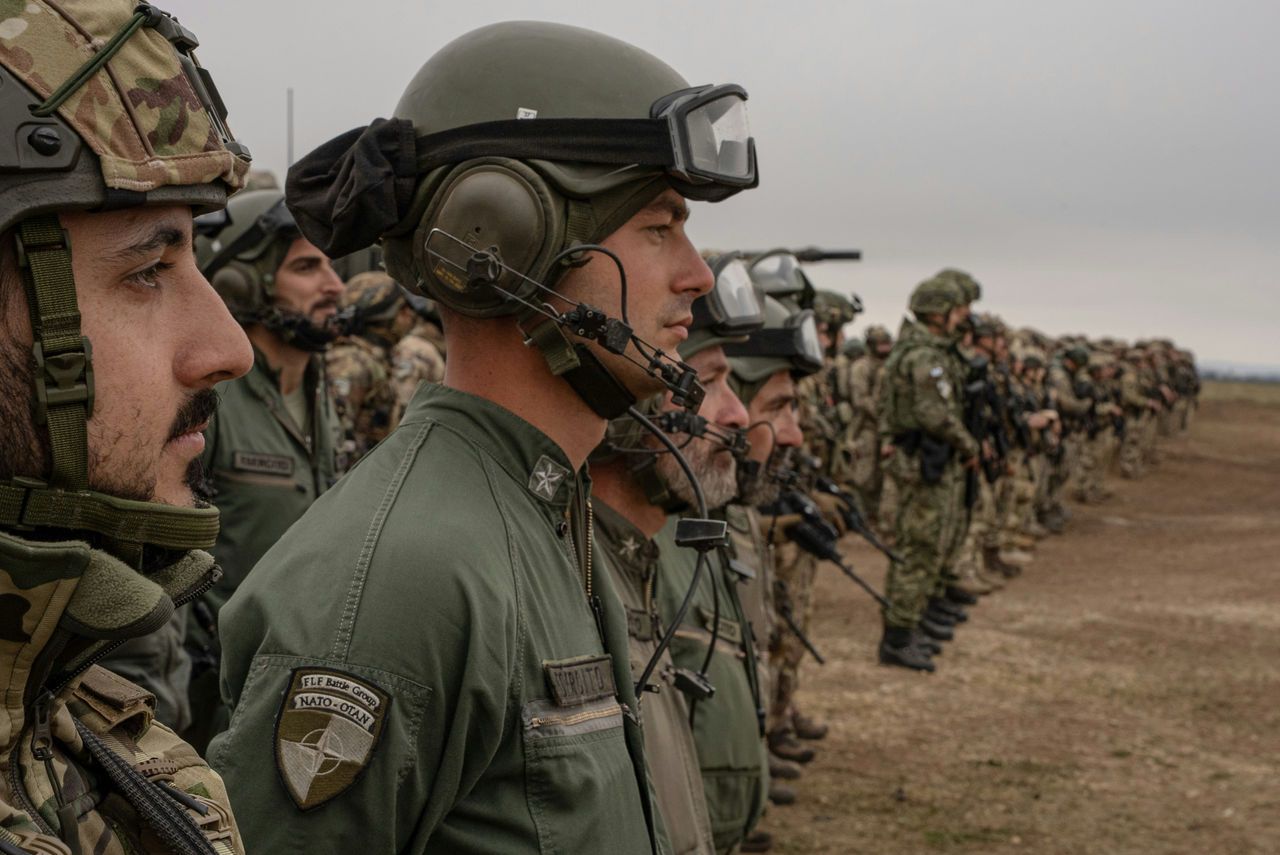
The featured photo depicts troops from NATO’s Forward Land Forces (FLF) multinational battlegroup in Hungary standing alongside one another during a large-scale military exercise in September 2025.
Democratic security comes at a price. What is yours?
Subscribe now for full access to expert analysis and policy debate on Central Europe.
Commentary
Democratic Security
The Deafening Silence of Poland in Europe
5 October 2026
Commentary
Democratic Security
Few Reasons to Worry About Latvian Trump
1 October 2026

Analysis
Democratic Security
Hungary-Ukraine Spat Gains a New Dimension – OVERVIEW
1 October 2026
Democratic Security
Interview
If Russia is the Storm, China is Climate Change – INTERVIEW
24 September 2026