

4 March 2025
Navigate to:
Europe On Edge Homepage
Editorial: Building Strategic Communication on the European Union in Poland
Recommendations
As old narratives about the EU wear off, new negative sentiments are emerging in the absence of new positive ones.
This is especially the case in the context of the Green Deal and the farmers’ protests, which were supported by 76% of respondents in February 2024 (Ipsos 2024). With regards to restrictions on farmers, the issue of agricultural imports and grain from Ukraine, parts of the population cease to see what in previous years were positive aspects of membership, such as subsidies for farmers. In February 2024, 75% of respondents (of which 50% strongly) indicated that they were closer in position to Polish farmers than defenders of the Green Deal (Ipsos 2024). In all groups distinguished by political views, support for farmers outweighed support for the Green Deal, including among Civic Coalition voters (65% supported farmers) and Left voters (58%) (Ipsos 2024).

To a large extent, this is because Poland lacks a coherent narrative and communication strategy about the European Union. The country’s political transformation was accompanied by the slogan ‘return to Europe’, but today the youngest generations of voters, among whom there is considerable support for anti-EU parties, do not remember a world in which Poland was not part of the EU. The advantages experienced and observed by middle-aged and older people are a stagnant reality for the youngest generations.
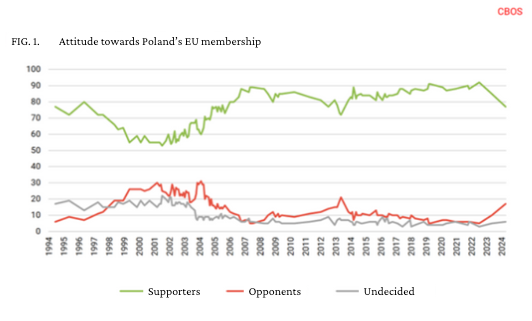
Source: CBOS (2024 a).
The percentage of those in favour of EU integration in CBOS surveys has never been below 50%, and even happened to exceed 90%. Nevertheless, in recent years (CBOS 2024 a), we have seen a decline in Poland’s support for the EU. In 2024, 77% of respondents support Poland’s presence in the alliance – this is 8 percentage points less than in 2023 and 15 less than in 2022. 17% of respondents are against Poland’s presence in the EU.
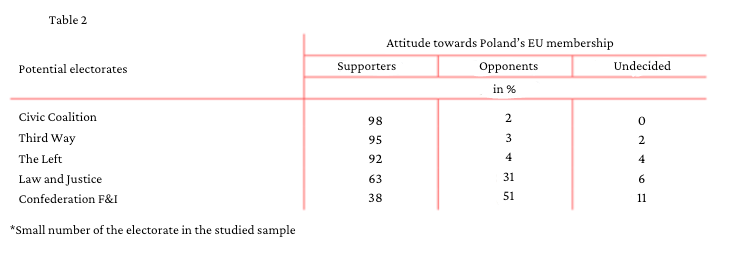
Source: CBOS 2024 a.
Supporters of Poland’s membership in the European Union dominate in all the socio-demographic groups distinguished in the CBOS survey (2024 a). The greatest differences can be seen when the population is distinguished by political and worldview orientation. EU membership is supported by 94% of respondents identifying with left-wing values (5% against) and 64% declaring right-wing political views (30% against).
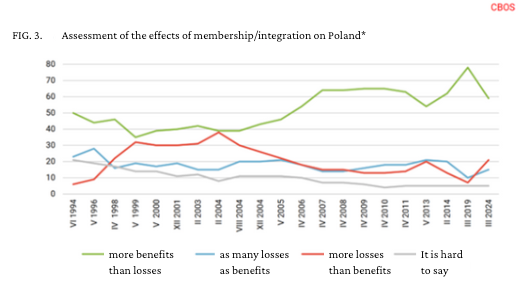
Source: CBOS 2024 a.
The majority still believes that Poland gains more than it loses from EU membership, but the percentage of indications in favour of this answer has also been falling (CBOS 2024 a) – over the past 5 years, it has decreased by 19 percentage points. More than one in five respondents (21%) believe that Poland loses rather than gains from EU membership.
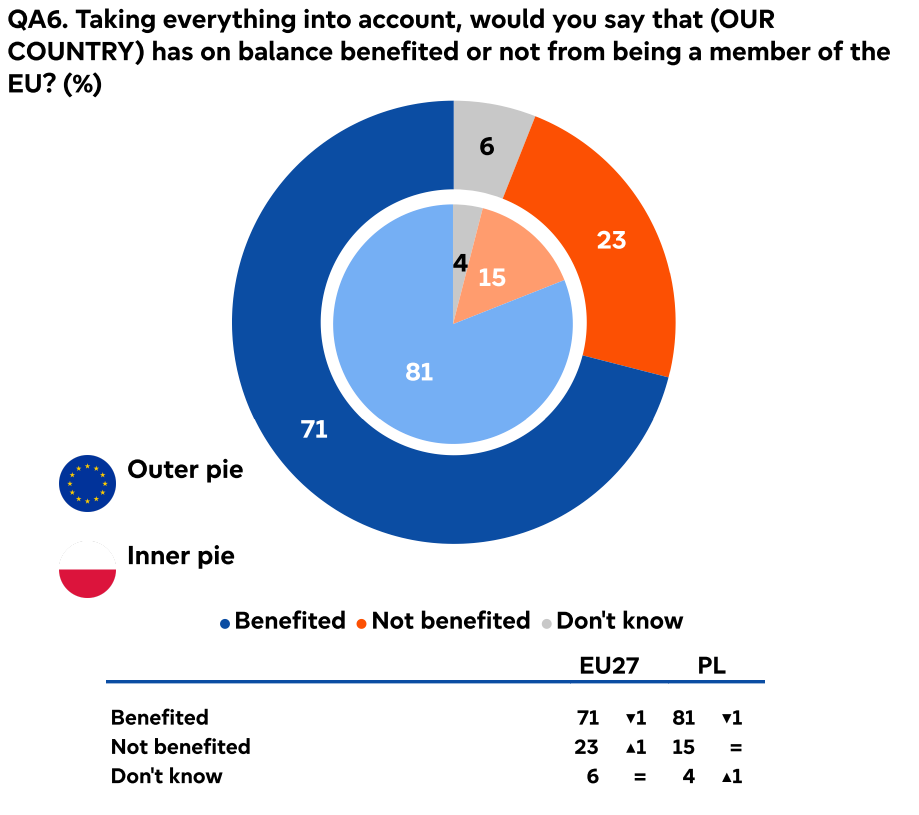
Source: Eurobarometer 2024.
Nonetheless, despite the falling percentage of people agreeing with the statement that Poland has benefited from membership, it is higher than the EU average: 81% and 71% respectively (Eurobarometer 2024).
Changes in thinking about the EU have been linked, among other factors, to the Union’s actions in the face of such global challenges as the war in Ukraine, climate change and migration.
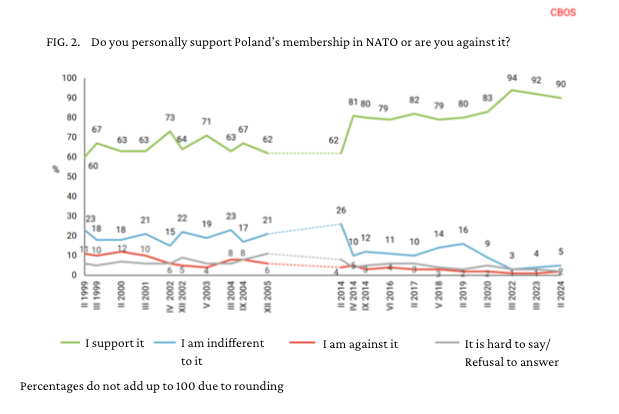
However, the changes noted over the last few years are not necessarily a permanent trend towards lower support for EU membership. One example of this is the change in perception of Poland’s membership in NATO (CBOS 2024 b).
Source: CBOS 2024 b.
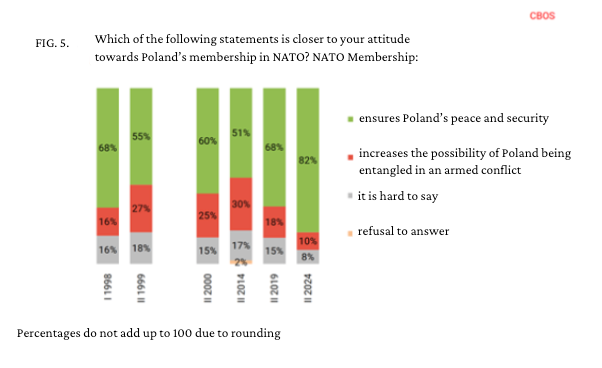
The full-scale invasion of Ukraine has translated into increased support for Poland’s presence in NATO (CBOS 2024 b). NATO is now perceived as an organisation that provides peace and security for Poland. Support for such a statement has increased since 2019 by 14 percentage points, from 68% to 82% (CBOS 2024 b).
Source: CBOS 2024 b.
Therefore, one may wonder whether the EU could gain more supporters in Poland if it was also associated with security or other values that are important to Poles. In this context, one can consider how challenges and solutions are addressed and communicated to a wider audience.
Source: Eurobarometer 2024.
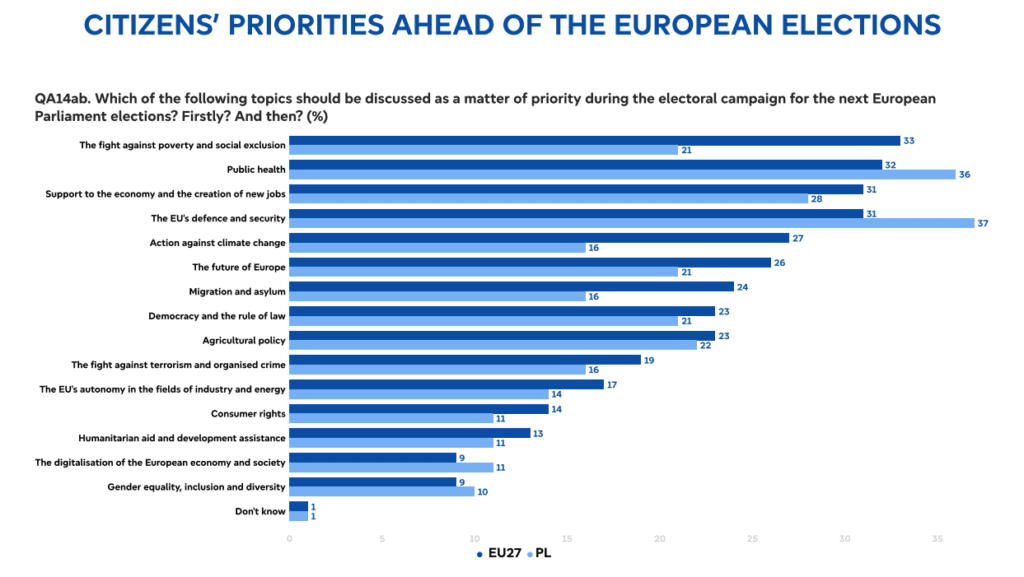
Linking the EU to security could become an effective narrative, since, according to Poles, the priority during the European Parliament elections should have been precisely EU defence and security (37% of indications in Poland, 31% for the EU27) (Eurobarometer 2024).
Source: Eurobarometer 2024
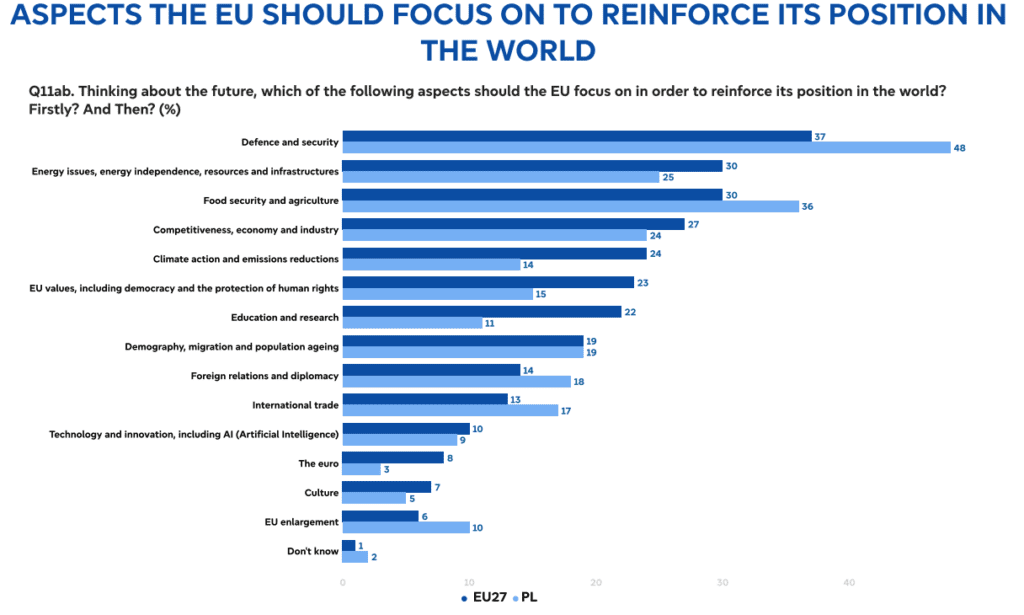
Security is also an issue that will strengthen the Union’s position in the world (according to 48% of respondents in Poland, 37% EU27) (Eurobarometer 2024).
Source: Eurobarometer 2024.
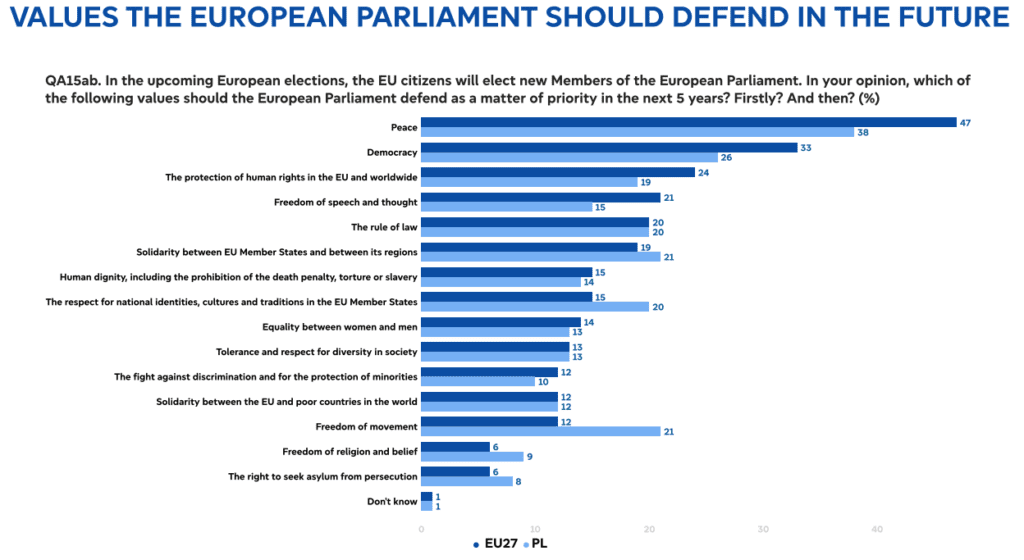
Unsurprisingly given this context, the value that Poles believe the European Parliament should defend above all is peace (47% of indications, against 38% from the EU27) (Eurobarometer 2024).
The theses of this report, confirmed by the above statistics, were derived from the c The choice of city was determined by:
Such parameters resulted in these four cities being high on the list of interesting research cases. Elbląg’s location near the Russian border forced the city, among other things, to prepare a library digitisation system for literary works. Sosnowiec, on the other hand, was and is a highly industrialised area (Special Economic Zone).
The Res Publica Foundation’s project from 2023 to 2024 aimed at bridging the divide and supporting communication between political leaders and citizens so that the public would be given the opportunity to communicate directly to politicians and be assured that ideas coming from a local level would be taken into account in broader political discourse.
The interviews were also designed to listen in to the voices of local opinion leaders and politicians in these four, carefully selected Polish cities – the aforementioned Przemyśl, Radom, Elbląg and Sosnowiec – in order to be able to provide them with a platform for discussion when confronted with big political actors, including Polish politicians in Brussels, in the government as well as high-ranking officials.
The objectives of the project are:
By creating a conducive democratic ecosystem for communities whose voice has hitherto been absent from public debate, we aim to build democratic resilience, connecting these groups through a shared understanding of key risks.
Public awareness and responsiveness to these policies are essential for good governance. The project stimulates open public debate through events and media. It also helps EU and Polish government planners and decision-makers to shape policies, taking into account both expert input and public response.
By animating discussions on democracy in Poland, we have created local platforms for the exchange of ideas that increase the involvement of an active civil society.
CBOS (2024 a), 20 lat członkostwa Polski w UE, Komunikat z badań nr 43/2024, Fundacja Centrum Badania Opinii Społecznej, Warszawa.
CBOS (2024 b), 25 lat członkostwa Polski w NATO, Komunikat z badań nr 24/2024, Fundacja Centrum Badania Opinii Społecznej, Warszawa.
Eurobarometer (2024), EP Spring 2024 Survey: Use your vote – Countdown to the European elections, https://europa.eu/eurobarometer/surveys/detail/3272
Ipsos (2024), https://oko.press/protest-rolnikow-poparcie-coraz-bardziej-partyjne
We would like to thank our Partners who significantly supported the organisation of events and mediated in establishing the first contacts with local leaders. They are: Igor Horków and Katarzyna Mycyńska-Komar, Dom Ukraiński in Przemyśl; Karolina Adamczyk, Urszula Malmon, American Corner in Radom; Jacek Nowiński, Biblioteka Elbląska; Janusz Kubicki, Fundacja IV LO im. S. Staszica in Sosnowiec.
We would like to thank Stanisław Kluza, Roman Kuźniar, Artur Nowak-Far, Ewa Moncure, Robert Sobiech, Jolanta Szymańska, Marek Tatała and Paweł Wojciechowski for consulting the working version of this text.
Author of the report
Dr Anna Kuczyńska is assistant professor at the Department and Institute of Sociology of Collegium Civitas. Deputy Editor-in-Chief of “Res Publica Nowa”. She graduated in sociology from the University of Warsaw and the Polish School of Reportage (Polska Szkoła reportażu) at the Institute of Reportage and obtained a PhD in social sciences on digital competences at the Faculty of Sociology of the University of Warsaw.
At Collegium Civitas, she teaches classes related to quantitative research methods, statistics and data analysis in the programme R, but also online ethnography devoted to qualitative research. She is a member of the editorial board of the revised annual Zoon Politkon.
Previously, she conducted classes, among others, at the Polish-Japanese Academy of Information Technology and research for cultural institutions such as the Copernicus Science Center, Zachęta National Gallery of Art, POLIN Museum of the History of Polish Jews, and the Museum of Municipal Engineering, using both quantitative and qualitative methods.
Editors
Galan Dall
Staś Kaleta
Project Manager
Magdalena Przedmojska
Contact:
Fundacja Res Publica
ul. Gałczyńskiego 5
Warszawa
fu******@*********ca.pl
Navigate to:
Europe On Edge Homepage
Editorial: Building Strategic Communication on the European Union in Poland
Recommendations